Overview
Microbiological contaminants in cocoa are bacteria, yeasts and moulds, and their spores, that are present in a product where they should not be or above an agreed limit. They fall into three groups: pathogens (Salmonella), indicator organisms (Enterobacteriaceae, coliforms, E. coli) and spoilage organisms (total plate count, yeast, mould).
Cocoa’s low water activity stops these organisms growing but does not remove them, so contamination can enter at drying, storage, shipping or processing without changing how the product looks or smells. Cocoa microbiological specifications turn these risks into testable limits. A full specification sheet adds mycotoxins, contaminants such as cadmium and PAH4, and physical and chemical parameters like moisture. Contaminant limits are EU law. Microbiological limits are industry standards.
Absent in 375 gSalmonella test, industry standard
3.0 µg/kgochratoxin A, cocoa powder (EU law)
5.0 and 30 µg/kg fatbenzo(a)pyrene and PAH4 (EU law)
0.60 mg/kgcadmium, cocoa powder (EU law)
7.5% maxcocoa bean moisture, ISO 2451:2017
1.75% maxfree fatty acid, cocoa butter (EU)
0.75% maxforeign matter in beans, ISO 2451:2017
30 Dec 2026EU deforestation rules start for large operators
In this guide
The risk
Contamination is invisible, and it happens
A 2011 survey of 25 commercial cocoa powder samples, published in Food Microbiology by researchers at Wageningen University, found that 17 samples complied with industry microbiological guidelines. One sample was Salmonella-positive, five were Enterobacteriaceae-positive, and two had mould levels just above the maximum admissible level (Líma et al., 2011).
Two 2022 incidents in Belgium show how Salmonella reaches chocolate. Barry Callebaut halted production at its Wieze plant after Salmonella was found, and the company named lecithin, an ingredient, as the source (Food Safety News). At Ferrero’s Arlon plant, Salmonella was discovered on 15 December 2021 on a filter on two raw-material reservoirs (Belga News Agency).
Neither case started with a contaminated cocoa bean. Both started with ingredients or equipment inside the factory. That is why a specification sheet has to be read together with a supplier’s hygiene controls.
The full panel
Full Cocoa Powder Specification Table
One table holds the cocoa microbiological specifications and every other limit. “Typical” means a common commercial specification that buyers and suppliers agree by contract. It is not a legal limit.
| Category | Parameter | Specification | Basis |
|---|---|---|---|
| Physical | Moisture (beans) | 7.5% max | ISO 2451:2017 |
| Physical | Moisture (powder) | 5% max, typical | Commercial specification |
| Physical | Fat content | 10 to 12% (standard) or 20 to 22% (high-fat), typical | Commercial grade selection |
| Physical | pH, alkalized powder | 6.8 to 8.1, typical | Process specification |
| Physical | pH, natural powder | 5.2 to 5.8, typical | Process specification |
| Physical | Particle size | 99% through 200 mesh, typical | Commercial specification |
| Physical | Foreign matter (beans) | 0.75% max of sample mass | ISO 2451:2017 |
| Chemical | Free fatty acid (cocoa butter) | 1.75% max, as oleic acid | Directive 2000/36/EC, Annex I |
| Contaminants | Cadmium (cocoa powder for final consumer) | 0.60 mg/kg max | EU Regulation 2023/915, point 3.2.15.4 |
| Contaminants | Ochratoxin A (cocoa powder) | 3.0 µg/kg max; no limit for beans | EU Regulation 2023/915, point 1.2.16 |
| Contaminants | Aflatoxin | No cocoa-specific EU limit | Set contractually |
| Contaminants | Benzo(a)pyrene | 5.0 µg/kg fat max (cocoa beans and derived products) | EU Regulation 2023/915 |
| Contaminants | Sum of PAH4 | 30.0 µg/kg fat max (cocoa beans and derived products) | EU Regulation 2023/915 |
| Microbiological | Total Plate Count | 5,000 CFU/g max, typical | Industry practice (CAOBISCO/ECA guidance) |
| Microbiological | Yeast | 50 CFU/g max, typical | Industry practice |
| Microbiological | Mould | 50 CFU/g max, typical | Industry practice |
| Microbiological | Enterobacteriaceae | Negative/g | Industry practice |
| Microbiological | Coliforms | Negative/g | Industry practice |
| Microbiological | E. coli | Negative/g | Industry practice |
| Microbiological | Salmonella | Negative/375 g (25 g as a minimum) | Industry practice |
Radad International tests its cocoa against this panel. The sections below give the basis for each parameter. Read our company profile for who we are and where we source.
1Law or industry standard
The Regulatory Overview: What’s Legally Binding (and What Isn’t)
Coverage is uneven. Some limits apply to raw beans, some only to finished cocoa powder, and some risks have no limit at all. Each section states which category a limit falls into.
Industry standard, not law
Microbiological limits
Regulation (EC) No 2073/2005, the EU’s microbiological criteria regulation, sets no criteria specific to cocoa or cocoa powder.
The limits suppliers test against (Salmonella, Enterobacteriaceae, total plate count, yeast, mould) come from industry practice, guided by the quality guide that CAOBISCO and the European Cocoa Association (ECA) publish at cocoaquality.eu.
Buyers in Europe, the Gulf and North America specify against these limits regardless of their non-statutory status.
Binding law
Contaminant limits
EU Regulation 2023/915 sets binding maximum levels for contaminants including cadmium, ochratoxin A and PAHs. It replaced Regulation (EC) No 1881/2006.
A supplier can cite a regulation number for these. For microbiology there is none.
Red flag
A supplier who says an EU regulation sets cocoa microbiological limits is misinformed or misrepresenting their compliance position.
2Microbiology
Cocoa Microbiological Specifications
Cocoa microbiological specifications are not set by EU law. Buyers and suppliers agree them by contract, using industry guidance, and test them on every batch.
Salmonella
Salmonella is the pathogen every cocoa buyer cares about most. Cocoa’s low water activity and high fat content do not let it grow, but they make it harder to kill: a study cited by laboratory-standards provider LGC found that low water activity increases the pathogen’s thermal resistance, so heat treatment must be validated rather than assumed (LGC Standards).
The industry specification is absence in a defined sample weight. 25 g is the standard laboratory portion; chocolate-industry sampling plans increasingly test 375 g portions, because contamination is sporadic and a 25 g portion rarely captures it.
Where the risk sits
Salmonella can enter through raw material (beans exposed to soil, animals or unclean water), through other ingredients added after heat treatment, and through equipment and the processing environment. Testing therefore has to cover the finished product, and a supplier’s factory hygiene audit matters as much as their sourcing.
Enterobacteriaceae and coliforms
Enterobacteriaceae (a family that includes E. coli and coliforms) are indicator organisms. Their presence does not necessarily mean the product is unsafe, but it flags a hygiene failure that warrants investigation. In the 2011 survey, five of 25 samples carried Enterobacteriaceae while only one carried Salmonella. Indicators are the more sensitive early warning.
Total plate count, yeast and mould
These three tests describe the general microbiological load of a batch: how clean the processing environment and drying were, in aggregate. In the 2011 survey, 36% of samples also carried heat-resistant spore-forming bacteria, mostly of the Bacillus subtilis complex. A typical commercial specification for alkalized cocoa powder sets these limits:
| Parameter | Typical industry limit | What it indicates |
|---|---|---|
| Total Plate Count (TPC) | 5,000 CFU/g max | Overall hygiene of processing and handling |
| Yeast | 50 CFU/g max | Moisture ingress, inadequate drying, or storage humidity |
| Mould | 50 CFU/g max | As above; often correlates with moisture above specification |
| Enterobacteriaceae | Negative/g | Faecal or post-process hygiene failure |
| Coliforms | Negative/g | As above |
| E. coli | Negative/g | Direct faecal contamination indicator |
| Salmonella | Negative/375 g | The critical pathogen test; must always be negative |
Typical commercial limits, consistent with cocoa-industry guidance. Your buyer’s own specification takes precedence.
Read the tests together
A yeast or mould count creeping toward the limit is often the first sign of a moisture problem. Read these results alongside the moisture reading (section 6), not in isolation.
3Mycotoxins
Mycotoxins: Ochratoxin A and Aflatoxin
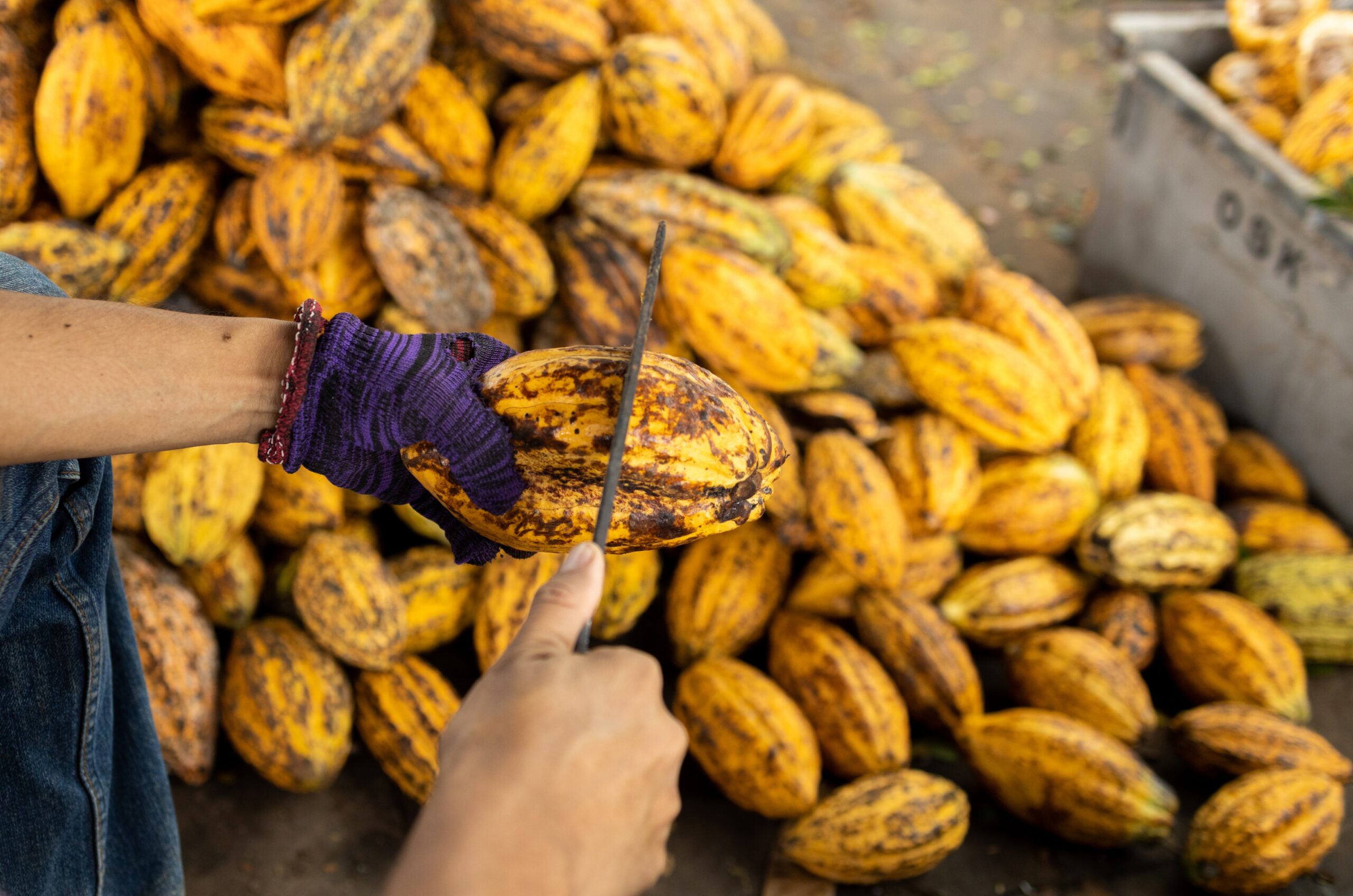
Mycotoxins are toxic metabolites produced by moulds, principally Aspergillus species. They are the contaminant class most directly caused by poor post-harvest handling: beans dried too slowly, stored too damp, or held too long before shipment.
Ochratoxin A (OTA)
The EU sets a maximum OTA level of 3.0 µg/kg for cocoa powder (point 1.2.16 of Annex I to Regulation 2023/915). The limit was introduced by Regulation (EU) 2022/1370, applied from 1 January 2023, and now sits in the consolidated 2023/915.
A gap that catches buyers out
The EU sets no OTA limit for cocoa beans. A supplier can legally sell beans whose OTA level would fail the powder limit once processed, because the bean sits outside the regulation. If you buy beans to process yourself, write a bean-level OTA limit into the contract.
OTA concentrates in the shell and outer layers of the bean, so careful deshelling reduces carryover into powder and nibs. It forms mainly during slow or interrupted drying and damp storage. The Codex Alimentarius Code of Practice for the prevention and reduction of OTA contamination in cocoa (CXC 72-2013) is the reference most origin-side quality programmes work from.
Aflatoxin
The EU has not set an aflatoxin maximum level for cocoa beans or cocoa products. Aflatoxins are classified as carcinogenic to humans (Group 1) by the International Agency for Research on Cancer, and they remain a recognised risk wherever cocoa is stored in humid conditions.
“Not legally required” is not the same as “not a risk”, so cautious buyers specify their own aflatoxin limits in contracts. National limits elsewhere are useful benchmarks:
| Jurisdiction | Aflatoxin limit | Product |
|---|---|---|
| European Union | No cocoa-specific limit | Cocoa beans or cocoa products |
| Brazil (ANVISA) | 10 µg/kg | Cocoa beans |
| Brazil (ANVISA) | 5 µg/kg | Cocoa products and chocolate |
| Japan | 10 µg/kg (AFB1) | Import enforcement threshold, applied case by case |
Brazilian and Japanese figures are national benchmarks and apply only in those markets.
Aflatoxin shares its root causes with OTA: beans held too long in humid conditions before drying, or drying that does not bring moisture down fast enough. The moisture and mycotoxin lines of a spec sheet describe the same failure from two angles.
4PAH4
Polycyclic Aromatic Hydrocarbons (PAH4)
PAHs are combustion by-products. In cocoa they come from one practice: drying beans over open wood fires or with smoke-producing dryers, instead of clean indirect-heat drying or sun-drying. It is a processing choice, so it is avoidable.
EU Regulation 2023/915 sets two maximum levels for cocoa beans and derived products:
| Contaminant | EU maximum level | Applies to |
|---|---|---|
| Benzo(a)pyrene (BaP) | 5.0 µg/kg fat | Cocoa beans and derived products |
| Sum of PAH4 (BaP + benz(a)anthracene + benzo(b)fluoranthene + chrysene) | 30.0 µg/kg fat | Cocoa beans and derived products |
Both limits are expressed per kilogram of fat, not per kilogram of whole product. This matters when you compare a bean result with a cocoa butter result, because fat content differs enormously between product forms.
What to ask
Ask how the beans were dried. Sun-drying on raised beds, or indirect-heat drying with no smoke contact, essentially removes this risk. The Codex Code of Practice for the reduction of contamination of food with PAH from smoking and direct drying processes (CXC 68-2009) addresses the direct-flame pattern.
5Heavy metals
Cadmium and Heavy Metals
Cadmium is the heavy metal that matters most in cocoa. Cocoa trees take it up from the soil, so it is an origin issue that drying and cleaning cannot remove. EU Regulation 2023/915 sets maximum levels for finished cocoa and chocolate products:
| Product | Cadmium maximum (EU) | Point in Annex I |
|---|---|---|
| Milk chocolate, less than 30% total dry cocoa solids | 0.10 mg/kg | 3.2.15.1 |
| Chocolate with less than 50% total dry cocoa solids; milk chocolate with 30% or more | 0.30 mg/kg | 3.2.15.2 |
| Chocolate with 50% or more total dry cocoa solids | 0.80 mg/kg | 3.2.15.3 |
| Cocoa powder sold to the final consumer, or used as an ingredient in sweetened cocoa powder (drinking chocolate) | 0.60 mg/kg | 3.2.15.4 |
Beans have no EU limit
These limits apply to finished products, not to cocoa beans. A processor must therefore set a bean-level cadmium limit low enough that the finished powder or chocolate stays under the EU figure after blending. Some buyers contract a bean limit; ask your customer for their number and write it into the contract.
The sections of the regulation reviewed for this guide show no cocoa-specific maximum level for lead, so lead is normally covered by the buyer’s own specification and the heavy-metals panel on the certificate of analysis. Pesticide residues on cocoa beans fall under the EU’s maximum residue levels, searchable in the Commission’s EU Pesticides Database.
6Moisture
Moisture Content and ISO 2451
Moisture is the single parameter that most directly governs almost every other risk on this page. Mould growth, yeast counts and mycotoxin formation are all downstream of moisture control.
ISO 2451:2017, the international specification for cocoa beans, requires beans to be dried until moisture does not exceed 7.5% by mass (CAOBISCO/ECA quality guide). Some trade references quote 8% as a loading tolerance, so write the figure you mean into the contract. Our guide to sourcing bulk cocoa beans covers container condensation risk in more detail.
| Moisture reading | Practical implication |
|---|---|
| Below 6% | Beans are over-dried; can become brittle, and some flavour precursor loss may occur |
| 6% to 7.5% | Compliant with ISO 2451:2017; the range most buyers specify |
| Above 7.5% | Outside ISO 2451:2017; rising mould and mycotoxin risk; expect a claim or rejection |

Test moisture at origin before loading and, ideally, re-test on arrival. Beans can pick up moisture in a poorly ventilated or condensation-prone container, which is a separate risk from how they were dried.
Other ISO 2451:2017 quality limits
The same standard sets the physical grades that appear on a bean specification:
| ISO 2451:2017 parameter | Limit |
|---|---|
| Moisture content | 7.5% max (mass fraction) |
| Foreign matter | 0.75% max of sample mass |
| Cocoa-related matter (clusters, broken beans, fragments, shell pieces) | 3.5% max |
| Flat beans | 1.5% max |
| Mouldy beans, Grade I / Grade II (cut test, by count) | 3% / 4% |
| Slaty beans, Grade I / Grade II (cut test, by count) | 3% / 8% |
Sampling for these tests follows ISO 2292. Grade percentages are by count of the cut-test sample.
7Free fatty acid
Free Fatty Acid (FFA)
FFA is a quality parameter more than a safety one, but it is a standard line on a serious cocoa spec sheet because it is a reliable proxy for storage condition and bean integrity. FFA rises when lipase enzymes, often associated with mould activity, break down fat in poorly stored or damaged beans.
The EU definition of cocoa butter in Annex I of Directive 2000/36/EC sets a maximum free fatty acid content of 1.75%, expressed as oleic acid, and a maximum unsaponifiable matter of 0.5% (0.35% for press cocoa butter).
Citation updated
Many guides still cite Directive 73/241/EEC for this limit. That directive was repealed with effect from 3 August 2003, and Directive 2000/36/EC replaced it.
Test FFA on incoming lots rather than relying only on the exporter’s declared figure.
8Foreign matter
Foreign Matter and Filth Defects
This category covers foreign matter (non-cocoa material such as stones, sticks or dust) and filth defects (insects, insect fragments, mould and rodent contamination). The U.S. FDA treats the second group as adulteration and publishes “defect action levels”.
Foreign matter (ISO 2451)
ISO 2451:2017 caps foreign matter in cocoa beans at 0.75% of the reference sample mass.
FDA action levels: cocoa beans
FDA Compliance Policy Guide Sec. 515.775 sets the criteria for cocoa beans used to make cocoa powder and press cake:
| Defect (cocoa beans) | FDA action level |
|---|---|
| Moldy beans | Average of more than 4% by count |
| Insect-infested or insect-damaged beans | Average of more than 4% by count |
| Reject beans (moldy plus insect-damaged) | Average of more than 6% by count |
| Mammalian excreta | Average of 10 mg or more per pound |
FDA action levels: finished chocolate
For chocolate and chocolate liquor, Sec. 515.700 sets the thresholds:
| Defect (chocolate and chocolate liquor) | FDA action level |
|---|---|
| Insect fragments, average across six 100 g subsamples | 60 or more per 100 g |
| Insect fragments, any single subsample | 90 or more, even if the average is under 60 |
| Rodent hair, average across six 100 g subsamples | More than 1.0 per 100 g |
| Rodent hair, any single subsample | More than 3, even if the average is below 1.0 |
Both guides rely on 21 U.S.C. 342(a)(3), which treats a food containing a filthy or decomposed substance as adulterated.
A ceiling, not a target
These are the points at which the FDA may take enforcement action. A well-run supply chain, with proper drying, clean storage and pest-controlled warehousing, should produce results far below them.
9Looking ahead
What Is Changing
Three developments affect cocoa buyers in the next 12 months. Plan for each of them now.
Draft, not yet law
Mineral oil hydrocarbons (MOAH)
The EU member-state committee approved a draft amendment to Regulation 2023/915 on 13 May 2026. It covers cocoa beans, cocoa mass and cocoa powder, among other foods. Final Commission adoption was expected in autumn 2026, with entry into force intended for 2027 (Eurofins). Ask suppliers to avoid mineral-oil contact in packaging and handling.
In force from 30 December 2026
EU deforestation regulation
Cocoa is one of the commodities covered by the EUDR. Application has been postponed to 30 December 2026 for large and medium operators; micro and small operators follow later (European Commission). EU-bound buyers will ask for geolocation and traceability data.
Already applying
Ochratoxin A in cocoa powder
The 3.0 µg/kg limit has applied since 1 January 2023. Powder that was lawfully on the market before that date could stay on sale until its durability date, so any current stock should already comply.
10Destinations
Market by Market
The same lot faces different checks depending on where it is going. Start here, then confirm with your importer.
| Market | What the buyer or importer will look at | Where to check |
|---|---|---|
| European Union | Regulation 2023/915 contaminant limits, microbiological specification agreed by contract, pesticide residue limits, EUDR traceability from 30 December 2026 | EUR-Lex, EU Pesticides Database |
| United States | FDA defect action levels for beans (Sec. 515.775) and chocolate (Sec. 515.700); presence of Salmonella is a serious adulteration issue | FDA Compliance Policy Guides |
| UAE | Importer and product registration, a certificate of analysis, Arabic or bilingual labelling, and port inspection; some products also need halal certification | Dubai Municipality, ESMA, MoIAT, ADAFSA |
UAE requirements are summarised from industry guidance and change with each authority’s rules. Confirm registration, labelling and certificate requirements with the relevant authority before the first shipment.
11Buying checklist
What to Request From a Supplier
A complete certificate of analysis (COA) covers four categories. Use this table as a verification checklist against any COA you are shown:
| Category | Parameters to confirm are present |
|---|---|
| Physical / sensory | Moisture %, bean count per 100 g, cut test result, foreign matter %, colour (L*a*b* for powder), particle size (D50/D90 for powder) |
| Chemical | Fat content %, pH (for alkalized powder), free fatty acid % |
| Contaminants | Ochratoxin A, cadmium, PAH4/benzo(a)pyrene, heavy metals panel, aflatoxin if your contract sets a limit |
| Microbiological | Total plate count, yeast, mould, Enterobacteriaceae, coliforms, E. coli, Salmonella |
A COA that is not enough
Every COA must carry a batch or lot number, production date, testing laboratory name and issue date. A COA missing the microbiological section, or one that reads as a generic template rather than a batch-specific result, is not a valid basis for shipment release. Ask for a batch-specific re-test before accepting the goods.
Ask whether the laboratory is accredited to ISO/IEC 17025 for the methods it reports. Accreditation shows the lab’s methods and results have been independently assessed.
Pre-shipment vs on-arrival testing
A complete buying programme requires both. They answer different questions.
At origin, before the container is sealed
Pre-shipment testing
Confirms the product met specification at loading. Verify moisture, FFA, mycotoxins and the full microbiological panel here.
The verification should come from an independent third-party inspector (SGS, Bureau Veritas, Cotecna or equivalent), not only the exporter’s own laboratory.
At destination, before release
On-arrival testing
Catches what pre-shipment testing cannot: moisture pickup from condensation, temperature-driven mould growth, and pest ingress on a long or delayed voyage.
Re-test moisture, yeast and mould on arrival, even when a clean pre-shipment COA exists.
Sampling decides whether a result means anything
A single grab sample from one sack does not represent a 20-tonne lot. ISO 2292 specifies how to sample cocoa beans: how many increments to draw and how to build a representative composite. Confirm that any inspection agency or laboratory samples to this standard.
New to importing? Our step-by-step guide to importing cocoa powder shows where these checks fit in the buying process.
12Protect yourself
Contract Clauses That Make a Specification Enforceable
A limit that is not in the contract cannot be enforced. These clauses turn the figures in this guide into protection. Have your lawyer review the final wording.
- Write the limits down. State each limit with its unit and basis (for example, “µg/kg fat”), and name the product form it applies to.
- Fill the legal gaps. Add bean-level limits for ochratoxin A, aflatoxin and cadmium, because EU law sets none for beans.
- Name the standards and methods. Reference ISO 2451 for beans, ISO 2292 for sampling, and the test method for each parameter.
- Fix the laboratory rules. Require ISO/IEC 17025 accredited laboratories and an independent inspector at loading.
- Set the claim window. State how many days you have after arrival to report a deviation, and keep a sealed retained sample from every lot.
- Agree an umpire laboratory. Name a neutral laboratory whose result decides a dispute, and say who pays for the test.
- State the delivery term. FOB or CIF decides who carries risk during the voyage, which is when moisture pickup happens.
13Before you order
Pre-Order Checklist
Tick each item before you release payment:
- The product specification lists the cocoa microbiological specifications and every other parameter in the table above, with units.
- A batch-specific COA covers all four categories, including microbiology.
- The COA names an accredited laboratory, the lot number and the issue date.
- An independent inspector will verify loading, sampling and moisture.
- Bean-level limits for ochratoxin A, aflatoxin and cadmium are in the contract.
- You know how the beans were dried (sun, or indirect heat with no smoke contact).
- The supplier can show factory hygiene controls and a pest-control programme.
- You have a plan to re-test moisture, yeast and mould on arrival.
- Destination rules (labelling, registration, traceability) are confirmed with your importer.
Quotes from Radad
Need cocoa that meets this panel?
Tell us the product, pack size, quantity and destination port. We will send a quotation with the delivery term and the specification stated clearly, so you can compare it line by line.
Or call +971 52 250 1039
Questions
Frequently Asked Questions
What are cocoa microbiological specifications?
Cocoa microbiological specifications are the limits a buyer sets for Salmonella, Enterobacteriaceae, total plate count, yeast and mould, agreed by contract and verified on a certificate of analysis (COA). A full cocoa specification sheet also covers microbiological limits (Salmonella, Enterobacteriaceae, total plate count, yeast, mould), mycotoxins (ochratoxin A, aflatoxin), contaminants (cadmium, PAH4/benzo(a)pyrene) and physical and chemical parameters (moisture, free fatty acid, foreign matter). A complete COA reports a batch-specific result against each, not a generic product template.
Is Salmonella common in cocoa?
Detections are uncommon, and the risk is real. Cocoa’s low water activity stops Salmonella growing, yet makes it more heat-resistant, so heat treatment must be validated. Contamination can come from raw beans, from other ingredients added after heat treatment, and from equipment. The 2022 Barry Callebaut incident was traced to lecithin, an ingredient, rather than to the cocoa bean.
What sample size should a Salmonella test use?
25 g is the standard laboratory portion. Many chocolate-industry sampling plans test 375 g, because contamination is sporadic and a 25 g portion rarely captures it. The required result is absence either way.
Is there a legally binding EU limit for Salmonella in cocoa?
No. Regulation (EC) No 2073/2005, the EU’s microbiological criteria regulation, sets no criteria specific to cocoa or cocoa powder. The absence-in-25g or absence-in-375g standard is industry practice, not statute.
What does an Enterobacteriaceae or coliform positive mean?
It signals a hygiene control failure in processing, whether or not the organism found is itself pathogenic. Enterobacteriaceae is an indicator with a lower detection threshold than Salmonella, so it warns earlier and more often.
What do total plate count, yeast and mould results indicate together?
They quantify the aggregate microbiological load of a batch. Typical commercial limits are 5,000 CFU/g for TPC and 50 CFU/g for yeast and for mould. A count approaching the limit usually points to a moisture problem, so read it against the batch’s moisture result.
What is the EU limit for ochratoxin A in cocoa?
3.0 µg/kg for cocoa powder, under Regulation (EU) 2023/915 (point 1.2.16), applying since 1 January 2023. There is no EU limit for OTA in cocoa beans, so a buyer processing beans must set a bean-level limit in the contract.
Why does OTA concentrate in unshelled beans?
OTA accumulates in the shell and outer layers rather than the nib. Deshelling before further processing reduces carryover into the powder, so shelling method is a fair question in a supplier audit.
Is there an EU aflatoxin limit for cocoa?
No cocoa-specific limit exists in Regulation 2023/915. Aflatoxins are Group 1 carcinogens according to the International Agency for Research on Cancer, so buyers who want protection must specify a limit by contract. Brazil (10 µg/kg for beans, 5 µg/kg for cocoa products) and Japan (10 µg/kg AFB1 import threshold) are national reference points.
What causes OTA and aflatoxin contamination in cocoa?
Both form when beans dry too slowly, are stored too damp, or wait too long in humid conditions before drying. Controlling moisture and drying speed at origin controls both.
What is PAH4 and where does it come from in cocoa?
PAH4 is the sum of four polycyclic aromatic hydrocarbons: benzo(a)pyrene, benz(a)anthracene, benzo(b)fluoranthene and chrysene. In cocoa they come from drying beans over open fires or with smoke-producing dryers. Sun-drying or indirect-heat drying avoids them.
What is the EU limit for PAH4 and benzo(a)pyrene in cocoa?
Under Regulation (EU) 2023/915: 5.0 µg/kg fat for benzo(a)pyrene and 30.0 µg/kg fat for the sum of PAH4, for cocoa beans and derived products. Both are per kilogram of fat, so results for beans and cocoa butter are not directly comparable.
What is the EU cadmium limit for cocoa powder?
0.60 mg/kg for cocoa powder sold to the final consumer or used as an ingredient in drinking chocolate (point 3.2.15.4). Chocolate limits range from 0.10 to 0.80 mg/kg depending on cocoa solids. There is no EU cadmium limit for beans, so processors set bean limits themselves.
What moisture content should cocoa beans have?
ISO 2451:2017 requires beans to be dried until moisture does not exceed 7.5% by mass. Some trade references quote 8% as a loading tolerance, so state the figure in the contract. Radad International specifies 7% to 7.5% on outbound shipments.
Why does moisture matter more than any single contaminant test?
Mould growth, yeast proliferation and mycotoxin formation all follow a moisture control failure. One moisture reading is the most direct predictor of risk across most of the specification sheet.
What is the free fatty acid (FFA) limit for cocoa butter?
1.75% maximum, expressed as oleic acid, in the definition of cocoa butter in Annex I of Directive 2000/36/EC. The older Directive 73/241/EEC, often still cited, was repealed in 2003. FFA is a quality indicator of storage condition, not a direct food-safety parameter.
What is the ISO limit for foreign matter in cocoa beans?
0.75% of sample mass maximum under ISO 2451:2017. Foreign matter means non-cocoa material such as stones, sticks or dust.
How many insect fragments are permitted in chocolate under FDA rules?
The FDA may take action at an average of 60 or more insect fragments per 100 g across six subsamples, or 90 or more in any single subsample (CPG Sec. 515.700). This is an enforcement threshold under 21 U.S.C. 342(a)(3), not a production target.
What defect levels apply to raw cocoa beans under FDA rules?
Under CPG Sec. 515.775: an average of more than 4% moldy beans, more than 4% insect-infested or insect-damaged beans, or more than 6% reject beans by count, or an average of 10 mg or more mammalian excreta per pound.
What should be tested before shipment and on arrival?
Before shipment, an independent inspector should verify moisture, FFA, mycotoxins and the full microbiological panel at loading. On arrival, re-test moisture, yeast and mould, because condensation, temperature and pests can change a lot during the voyage.
Why is one grab sample from a shipment not enough?
Cocoa is not homogeneous within a lot. ISO 2292 defines how many increments to draw and how to build a representative composite sample. A result is only meaningful if the sample was drawn to that standard.
Will the EU deforestation regulation affect my cocoa purchase?
If you sell into the EU, yes. Cocoa is a covered commodity, and application starts on 30 December 2026 for large and medium operators. Expect requests for geolocation and traceability data from your supplier.
Are there EU limits for mineral oil hydrocarbons in cocoa?
Not yet. A draft amendment approved by member states on 13 May 2026 would add limits that include cocoa beans, cocoa mass and cocoa powder, with entry into force intended for 2027. Check the Official Journal for the final text.
Sources and references (checked 14 October 2026)
- Regulation (EU) 2023/915 on maximum levels for certain contaminants in food (cadmium point 3.2.15; ochratoxin A point 1.2.16; PAHs)
- Commission Regulation (EU) 2022/1370 (ochratoxin A), applied from 1 January 2023
- Regulation (EC) No 2073/2005 on microbiological criteria for foodstuffs
- Directive 2000/36/EC on cocoa and chocolate products (Annex I; repealed Directive 73/241/EEC from 3 August 2003)
- CAOBISCO/ECA, Cocoa Beans: Chocolate and Cocoa Industry Quality Requirements (ISO standards)
- ISO 2451:2017, Cocoa beans: specification and quality requirements; ISO 2292, Cocoa beans: sampling
- Codex Alimentarius: Code of Practice for the prevention and reduction of ochratoxin A contamination in cocoa (CXC 72-2013); Code of Practice for the reduction of contamination of food with PAH from smoking and direct drying processes (CXC 68-2009)
- U.S. FDA CPG Sec. 515.775, cocoa beans
- U.S. FDA CPG Sec. 515.700, chocolate and chocolate liquor
- Líma, Kamphuis, Nout and Zwietering (2011), Microbiota of cocoa powder, Food Microbiology 28(3):573-582
- Food Safety News (2022), Salmonella stops operations at Barry Callebaut chocolate plant
- Belga News Agency, Salmonella at Ferrero: contamination in Belgian factory
- LGC Standards, Salmonella in chocolate
- Eurofins, EU MOAH limits (draft approved 13 May 2026)
- European Commission, EUDR application dates
Keep reading
Related guides

Importing guide
How to Import Cocoa Powder in 8 Steps
From spec and supplier checks to FOB or CIF terms, shipping documents and customs.
Sourcing guide
How to Source Bulk Cocoa Beans
What importers should check before buying bulk African cocoa beans.
Product
Alkalized Cocoa Powder
Specifications, pack sizes and uses of Radad alkalized cocoa powder.