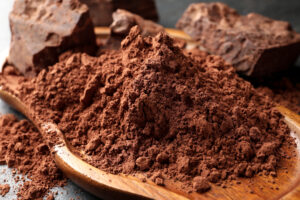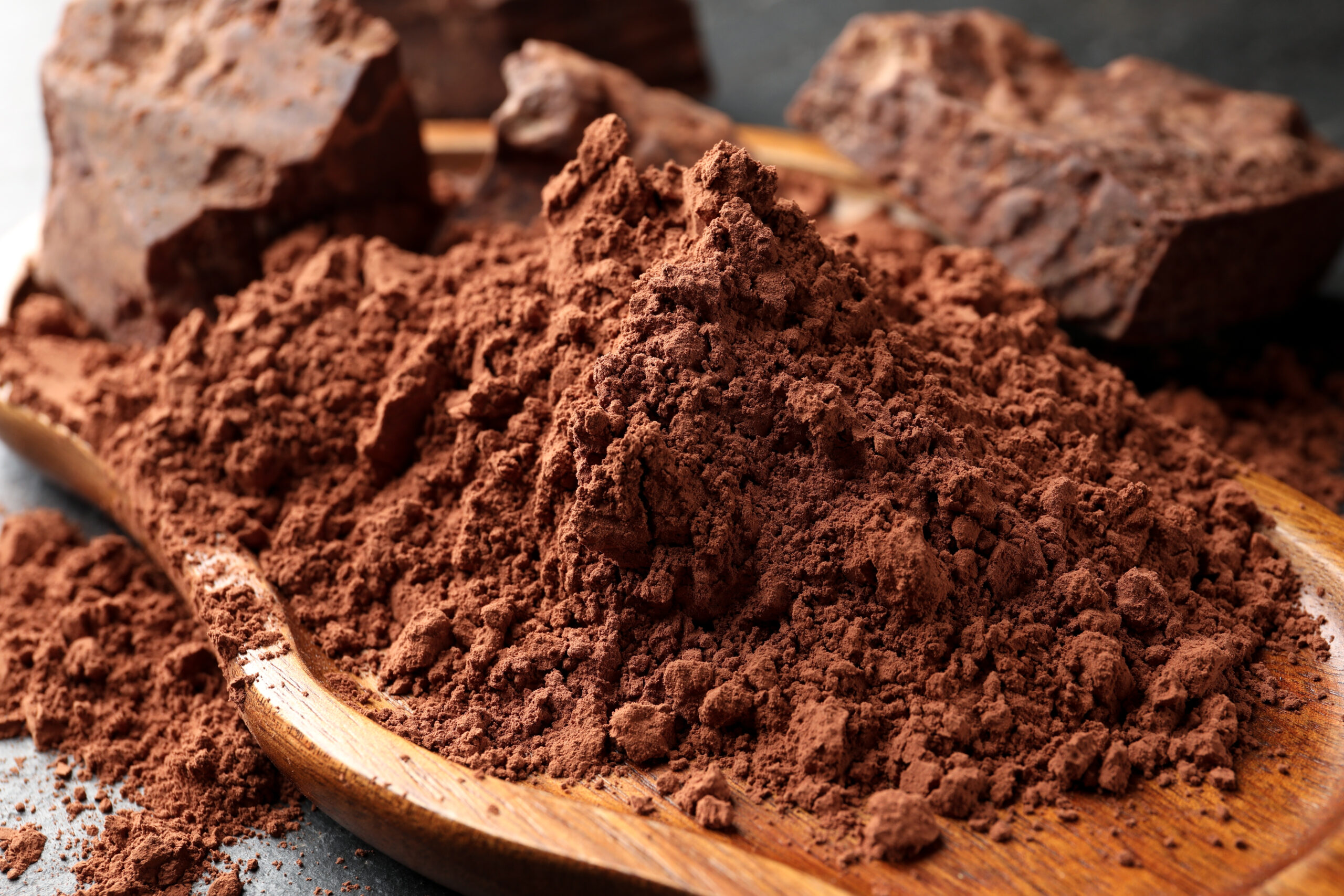
Two bags of cocoa powder can look identical on the shelf and behave very differently in your recipe. One pours like fine sand and dissolves in seconds. The other tastes rounder and richer, but clumps in cold milk. The difference is a single number on the specification sheet: how much cocoa butter the powder still holds.
Overview
In 10/12 vs 20/22 cocoa powder (also written 10-12 vs 20-22), the numbers are the cocoa butter content: 10/12 holds 10 to 12% and 20/22 holds 20 to 22%. Cocoa butter is the natural fat of the cocoa bean, and how much of it stays in the powder after pressing decides how the powder tastes, feels and behaves. Less fat gives a sharper cocoa note and a drier powder that pours and dissolves easily, which suits dry mixes, instant drinks, dairy products and coatings. More fat gives a richer, smoother result that suits cakes, brownies, hot chocolate and desserts.
Fat level is separate from colour and from alkalization, so both grades come natural or alkalized. It also affects price, the total fat in your recipe and, in some markets, the legal name of the powder: the EU treats powder under 20% cocoa butter as fat-reduced, and the US separates cocoa from breakfast cocoa at 22%. When you buy, ask the supplier to confirm the fat percentage in writing, and to say how it was measured in the laboratory. Then try a small sample in your own recipe before you place a full order.
10 to 12%cocoa butter in 10/12 powder
20 to 22%cocoa butter in 20/22 powder
20%minimum for “cocoa powder” in the EU (on dry matter)
22%minimum for “breakfast cocoa” in the US
Table of contents
Basic terms
Basic Terms
Cocoa buying uses specialist words. These twelve cover everything you need to read a 10/12 vs 20/22 cocoa powder specification with confidence.
Term
Cocoa butter
The natural fat in the cocoa bean. It is pale yellow, solid at room temperature and melts near body temperature. It is what makes chocolate melt in the mouth.
Term
Cocoa mass (cocoa liquor)
Roasted cocoa beans ground into a smooth paste. It contains both the fat and the solids of the bean. Despite the name, it has no alcohol.
Term
Cocoa cake
The solid block left after most of the butter is pressed out of cocoa mass. It is ground into cocoa powder.
Term
Cocoa solids
The non-fat part of the bean: the brown particles that carry the cocoa flavour and colour.
Term
Dry matter
The weight of a product with the water removed. EU law measures cocoa butter on dry matter, so moisture does not distort the figure.
Term
Fat-reduced cocoa powder
The EU legal name for cocoa powder with less than 20% cocoa butter on dry matter. A 10/12 powder falls here.
Term
Natural cocoa powder
Cocoa powder made without an alkali treatment. It is lighter in colour, slightly acidic and has a sharper, fruitier cocoa taste.
Term
Alkalized (Dutch-process) cocoa powder
Cocoa treated with an alkali to raise its pH. It is darker, milder in taste and mixes into liquids more easily.
Term
pH
A scale of acidity. Lower numbers are more acidic, higher numbers more alkaline. It decides colour and how cocoa reacts with baking soda.
Term
Fineness (particle size)
How small the ground particles are. Finer powder feels smoother and stays suspended in drinks longer.
Term
Dispersibility
How easily the powder spreads through a liquid without forming lumps.
Term
Fat bloom
The pale, greasy film that appears on chocolate when cocoa butter rises to the surface. It is harmless but looks poor.
Production
How Cocoa Powder Gets Its Fat Level
The fat level is decided at the pressing stage, not by adding or removing ingredients afterwards. The process runs in six steps:
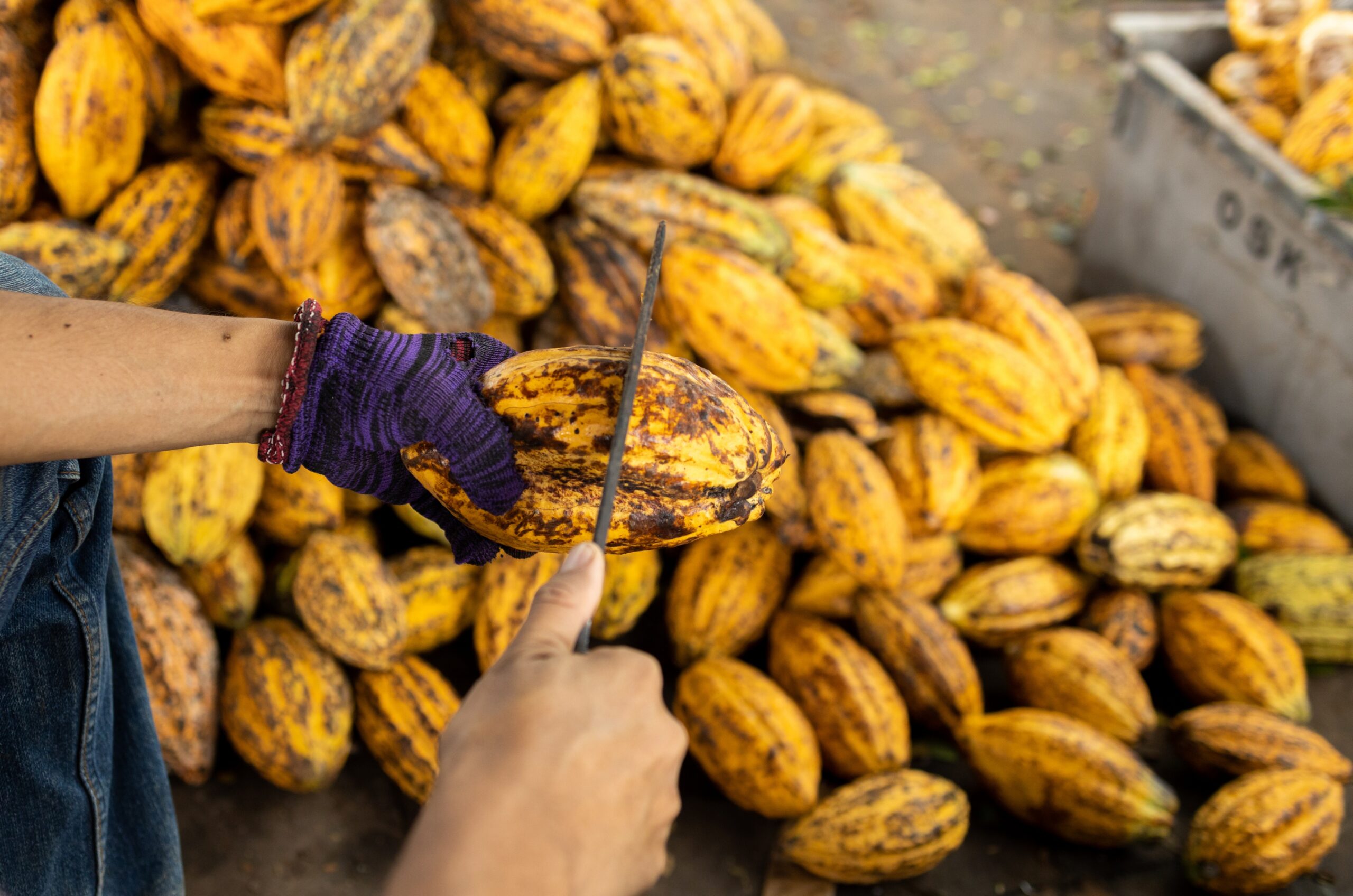
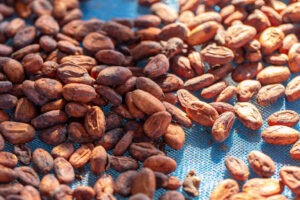
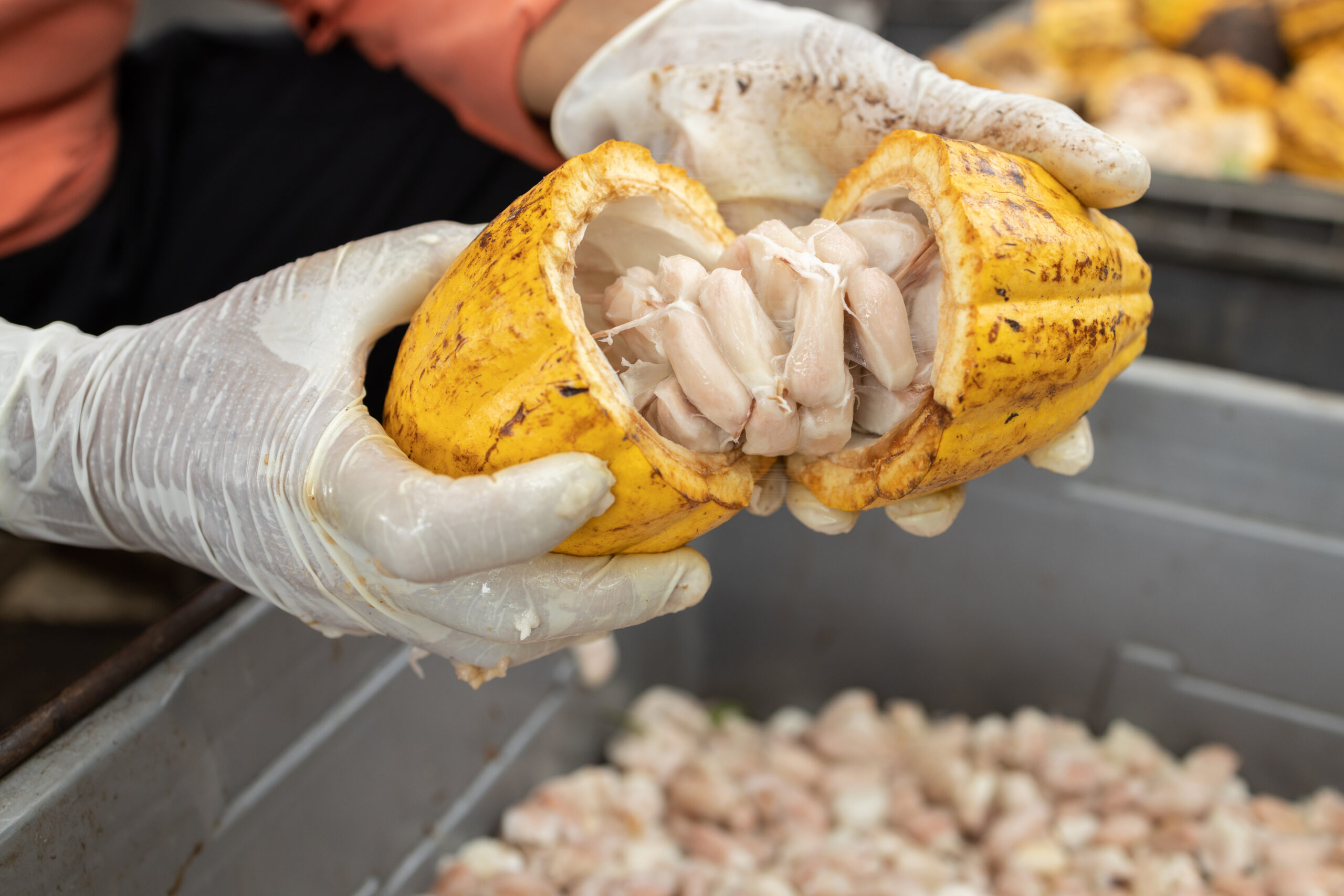
- Fermenting and drying: Farmers ferment and sun-dry the beans, which develops flavour and lowers moisture.
- Roasting and cracking: The beans are roasted, then cracked and winnowed to remove the shell, leaving nibs.
- Grinding: The nibs are ground into cocoa mass, which is about half cocoa butter.
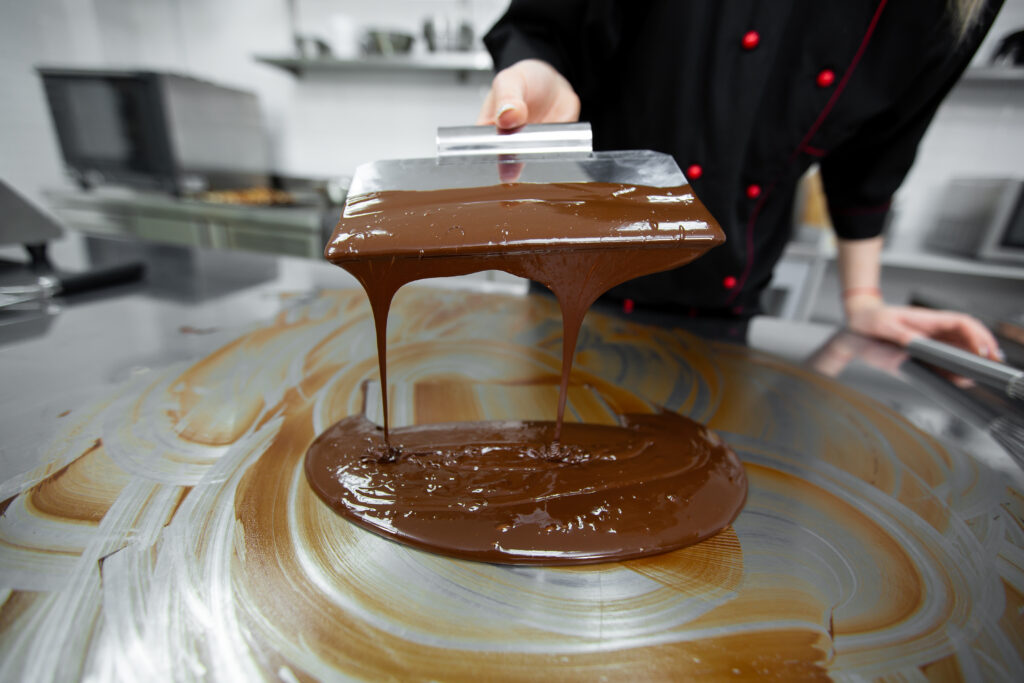
- Pressing: A hydraulic press squeezes cocoa butter out of the mass, leaving a solid cocoa cake.
- Powdering: The cake is broken up and milled into powder. Pressing harder removes more butter, giving a lower-fat powder such as 10/12. Pressing less leaves more butter, giving 20/22.
- Optional alkalizing: The nibs, mass or cake can be treated with an alkali to darken the colour and raise the pH.
Cocoa butter pressed out of the mass does not go to waste. It is sold as a product in its own right, which is why powder and butter prices move together.
Comparison
10/12 vs 20/22 Cocoa Powder Side by Side
| 10/12 cocoa powder | 20/22 cocoa powder | |
|---|---|---|
| Cocoa butter | 10 to 12% | 20 to 22% |
| Taste | Sharper, more intense cocoa note | Rounder, richer and fuller |
| Mouthfeel | Lighter and drier | Smoother and creamier |
| Powder behaviour | Flows freely, disperses easily, less caking | Can clump; needs good mixing |
| In a liquid | Mixes in readily | Can leave a fatty film if not blended well |
| In a bake | Strong cocoa taste, slightly drier crumb | Softer, moister crumb and richer taste |
| Colour effect | Colour comes mostly from the cocoa solids and pH | Colour comes mostly from the cocoa solids and pH |
| EU legal name | Fat-reduced cocoa powder | Cocoa powder |
| Typical buyers | Drink, dairy, coating and dry-mix manufacturers | Bakeries, dessert makers and chocolate-drink brands |
| Price | Quoted per kg and moves with the cocoa butter market. Compare on the same specification. | Quoted per kg and moves with the cocoa butter market. Compare on the same specification. |
The taste, mouthfeel and behaviour rows are general industry guidance. Always confirm with a sample, because origin, roast, fineness and alkalization change the result.
Effects
What the Fat Level Changes in Your Product
Taste
Flavour intensity
Less fat means more cocoa solids per gram, so the cocoa note is sharper. More fat softens and rounds the flavour.
Texture
Mouthfeel
Cocoa butter melts in the mouth. A 20/22 powder gives a smoother, creamier finish than a 10/12.
Handling
Flow and mixing
Fat makes particles stick. Lower-fat powder pours, sieves and disperses more easily in factories and in drinks.
Recipe
Total fat in the formula
Cocoa butter counts towards your recipe’s fat. Switching grades changes the total, which can change texture and set.
Nutrition
Labels and claims
A higher-fat powder adds more fat and energy to the finished product. Check your nutrition panel after any change.
Cost
Price per kg
Cocoa butter is valuable, so the fat level affects the price. Ask for quotes on the same specification before comparing.
Applications
Which Products Use 10-12 and Which Use 20-22?
Many foods use cocoa powder. The right fat level depends on whether the product is dry or wet, baked or blended, and how much fat the recipe already contains.
Usually 20/22
Bakery
Cakes, brownies, muffins, cookies, cupcakes and cake mixes that rely on a rich cocoa flavour and a soft crumb.
Both
Beverages
Hot chocolate and drinking chocolate lean to 20/22. Instant mixes, shake powders and ready-to-drink cocoa lean to 10/12.
Either
Ice cream and frozen desserts
Chocolate ice cream, gelato, frozen yogurt and lollies. Choose by the cocoa note and creaminess you want.
Usually 10/12
Confectionery
Compound coatings, truffle dusting, chocolate-flavoured fillings and decorations where the recipe adds its own fat.
Usually 10/12
Dairy
Chocolate milk, flavoured yogurt, pudding mixes and dairy desserts that need stable, even mixing.
Usually 10/12
Cereals and nutrition
Breakfast cereals, bars, protein powders and snack coatings that need free flow and clean dispersion.
Product by product
| Product | Usual choice | Reason (general guidance) |
|---|---|---|
| Cakes and brownies | 20/22 | Richer taste and a softer, moister crumb |
| Cookies and soft biscuits | 20/22 | Fat keeps them tender and rich |
| Crisp biscuits and wafers | 10/12 | Strong cocoa taste without extra softness |
| Hot chocolate and drinking chocolate | 20/22 | Creamy body and smooth finish |
| Instant drink and milk-powder mixes | 10/12 | Flows, dissolves and resists clumping |
| Chocolate milk and dairy drinks | 10/12 | Less free fat to separate in a liquid |
| Ice cream and frozen desserts | Either | 10/12 for a stronger cocoa note, 20/22 for a creamier body |
| Ganache, mousse and dessert sauces | 20/22 | Smooth texture and rounded flavour |
| Fillings, creams and spreads | Either | The recipe’s own fat is usually the bigger factor |
| Chocolate coatings and compounds | 10/12 | The formula adds its own fat, so the powder is kept lean |
| Truffle dusting | 10/12 | Dry, even, non-sticky finish |
| Cereals and snack coatings | 10/12 | Even coverage and easy handling |
| Protein and nutrition powders | 10/12 | Free flow and easy dispersion |
These are common industry choices, not rules. Many manufacturers use the other grade successfully. Test both in your own recipe.
Planning an import? Read how to import cocoa powder for the full buying process.
Substitution
Can You Swap 10/12 for 20/22?
Yes, but not as a straight one-for-one change without testing. The two powders carry different amounts of fat and cocoa solids, so a swap shifts flavour, texture and total recipe fat.
- Run a small trial batch before changing a production recipe.
- Taste and compare colour, texture and shelf behaviour side by side.
- Adjust added fat (butter, oil or vegetable fat) if the total fat has moved.
- Re-check the nutrition panel and the product name on the label.
- Re-test dispersion if the product is a drink or dry mix.
Compliance
Fat Level, Labels and the Law
Fat content is not only a quality choice. In the EU, Directive 2000/36/EC sets cocoa powder at not less than 20% cocoa butter, calculated on dry matter, and calls powder with less than 20% “fat-reduced cocoa powder”. A 10/12 powder is therefore fat-reduced by law, and a 20/22 powder sits just above the 20% line.
In the US, FDA rules define cocoa as having at least 10% but less than 22% cacao fat (21 CFR 163.113), and breakfast cocoa as at least 22% (21 CFR 163.112). A 20/22 powder can therefore fall on either side of that line, depending on the measured fat.
Check before you print a label
Ask your supplier for the measured fat on the certificate of analysis, and for the laboratory method used to measure it. Then check the product name on your pack against your market’s rule. Other markets set their own definitions, so confirm with your local food authority.
For the other limits on a specification sheet, see our cocoa specification and contaminant guide.
Colour
Fat Level Is Not the Same as Alkalization
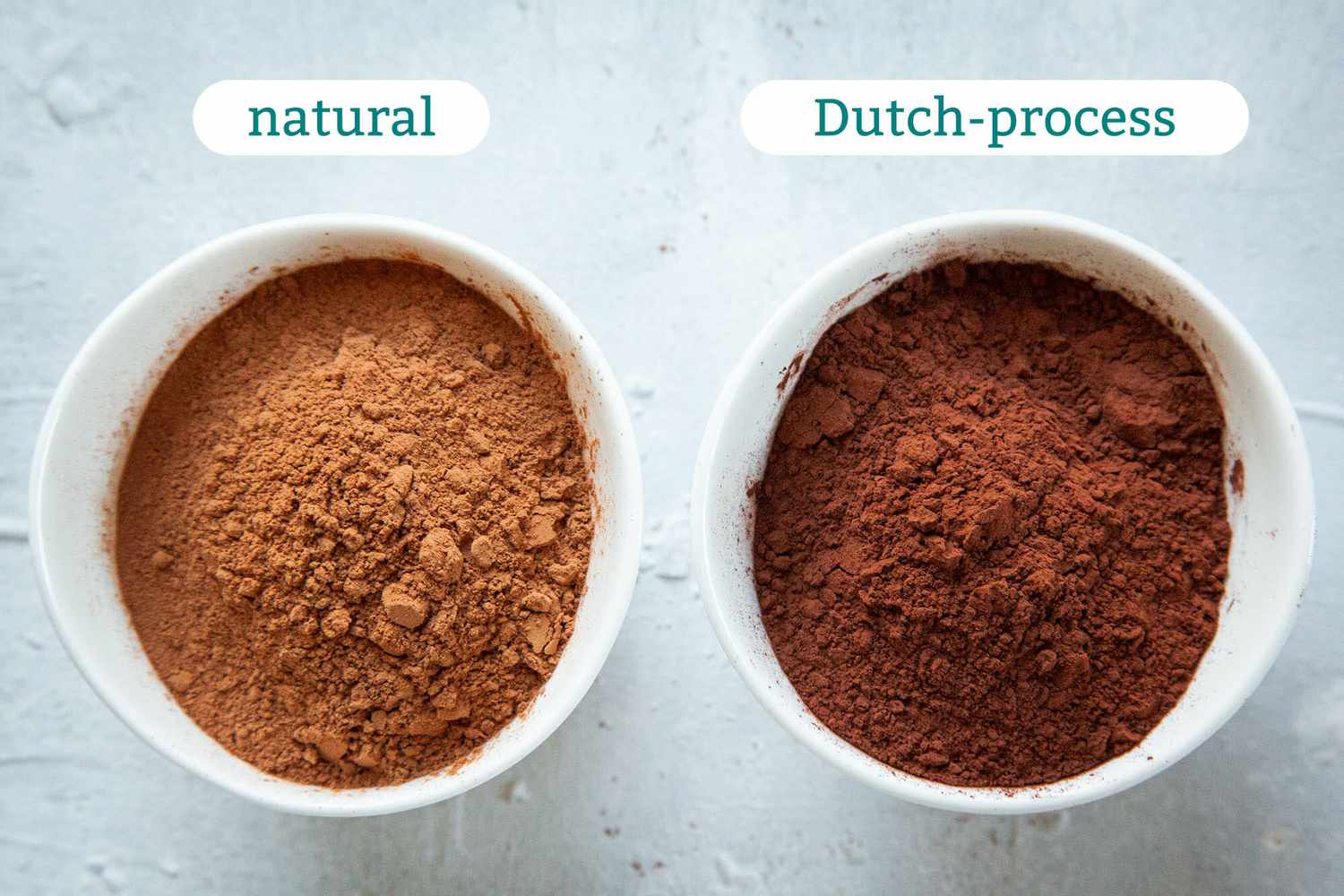
Fat level and alkalization are two separate choices. Fat is set by pressing. Alkalization is a treatment that changes colour, pH and flavour. You can buy 10/12 or 20/22 as natural cocoa powder or alkalized cocoa powder, giving four combinations.
| Natural cocoa powder | Alkalized (Dutch-process) cocoa powder | |
|---|---|---|
| Treatment | No alkali | Treated with an alkali |
| pH | Typically acidic, around 5 to 6 | Higher, commonly 6.8 to 8.5 |
| Colour | Lighter, reddish brown | Darker, from deep brown to near black |
| Taste | Sharper, fruitier | Milder, rounder |
| In liquids | Disperses less easily | Disperses more easily |
| Best with | Recipes using baking soda | Recipes using baking powder, drinks, ice cream |
Decide the fat range first, then the colour and pH that suit your recipe. Typical pH and colour ranges vary by supplier, so confirm them on the specification sheet.
Pitfalls
Common Mistakes When Choosing a Fat Level
- Comparing prices across different fat levels. A 10/12 and a 20/22 are different products. Compare quotes on the same specification.
- Writing a single number. Ask for a range, such as 10 to 12%, plus the laboratory method used to measure it, so every delivery matches.
- Confusing fat with colour. A darker powder is not a higher-fat powder. Colour comes from the cocoa solids and alkalization.
- Skipping the sample. Test both grades in your own recipe, at your own scale, before you commit.
- Ignoring the label rules. The legal name of the powder can change with its fat level in the EU and the US.
- Forgetting the rest of the specification. Moisture, fineness, pH, microbiology and contaminants matter as much as fat.
Buying
How to Specify and Buy Your Cocoa Powder
A good specification removes guesswork. Send your supplier this list with your enquiry:
- Cocoa butter as a range, for example 10 to 12% or 20 to 22%, and the laboratory method used to measure it
- Natural or alkalized, with the target pH and colour
- Moisture and fineness (particle size)
- Microbiological and contaminant limits for your market
- Pack size and delivery terms (FOB or CIF)
- A sample approved before the first full order
- A certificate of analysis with every shipment
Contaminant limits such as ochratoxin A, cadmium and Salmonella are set separately from fat. Our specification guide explains each one.
Work with Radad International
Tell us the fat level you need
Send your fat range, colour target, volume and destination, and we will reply with the matching specification sheet and a quotation. Or browse the range first.
Questions
Frequently Asked Questions
What does 10/12 mean in cocoa powder?
It means the powder contains 10 to 12% cocoa butter. 20/22 means 20 to 22%.
What is the difference between 10/12 and 20/22 cocoa powder?
The fat content. 20/22 holds roughly twice as much cocoa butter, so it tastes richer and smoother, while 10/12 has a sharper cocoa note and flows and disperses more easily.
Is 10/12 or 20/22 cocoa powder better?
Neither is better. 10/12 suits dry mixes, drinks, coatings and dairy products. 20/22 suits baking and desserts that need richness. Test both in your recipe.
Is 20/22 cocoa powder more expensive?
It depends on the market. Price follows the cocoa powder and cocoa butter markets, so compare quotes on the same fat range, pH, pack and delivery terms.
Can 10/12 and 20/22 powder be alkalized?
Yes. Fat level and alkalization are independent. Both grades are available natural or alkalized.
Is 10-12 cocoa powder the same as 10/12?
Yes. 10-12, 10/12 and 10 to 12% all describe the same thing: cocoa powder with 10 to 12% cocoa butter. The same applies to 20-22, 20/22 and 20 to 22%.
Does a higher fat level make cocoa powder darker?
No. Colour comes from the cocoa solids and from alkalization. A high-fat powder can be light or dark.
Which fat level is cocoa powder under EU law?
The EU defines cocoa powder as at least 20% cocoa butter on dry matter. Powder with less is fat-reduced cocoa powder, which includes 10/12.
Which cocoa powder is best for baking?
Many bakers choose 20/22 for cakes and brownies because the extra cocoa butter gives a richer taste and softer crumb. 10/12 works well in crisp biscuits and where a strong cocoa taste is needed.
Which cocoa powder is best for hot chocolate?
20/22 gives a creamier drink. For instant mixes that must pour and dissolve quickly, 10/12 is often preferred.
Which cocoa powder is best for ice cream?
Either can work. 10/12 gives a stronger cocoa note, and 20/22 gives a creamier body. Sample both.
Is 10/12 the same as low-fat cocoa powder?
Not exactly. In the EU, 10/12 is legally fat-reduced cocoa powder. In the US, “low-fat cocoa” has its own definition. Check the rule for your market.
Does cocoa powder with more fat spoil faster?
Cocoa butter is naturally stable, but any cocoa powder should be stored cool, dry and sealed. Higher-fat powder can cake more in warm, humid conditions, so storage matters.
How is the fat content of cocoa powder tested?
In a laboratory, using a standard method. Ask your supplier for the measured fat on the certificate of analysis, and the method used.
What other specifications should I check besides fat?
Moisture, fineness, pH, colour, microbiological limits and contaminant limits, plus pack size and delivery terms.
Where do I buy 10/12 or 20/22 cocoa powder in bulk?
From an exporter that gives a written specification, a certificate of analysis and a sample. Send Radad your fat range and volume to receive a quotation.
Keep reading
More Guides from Radad International
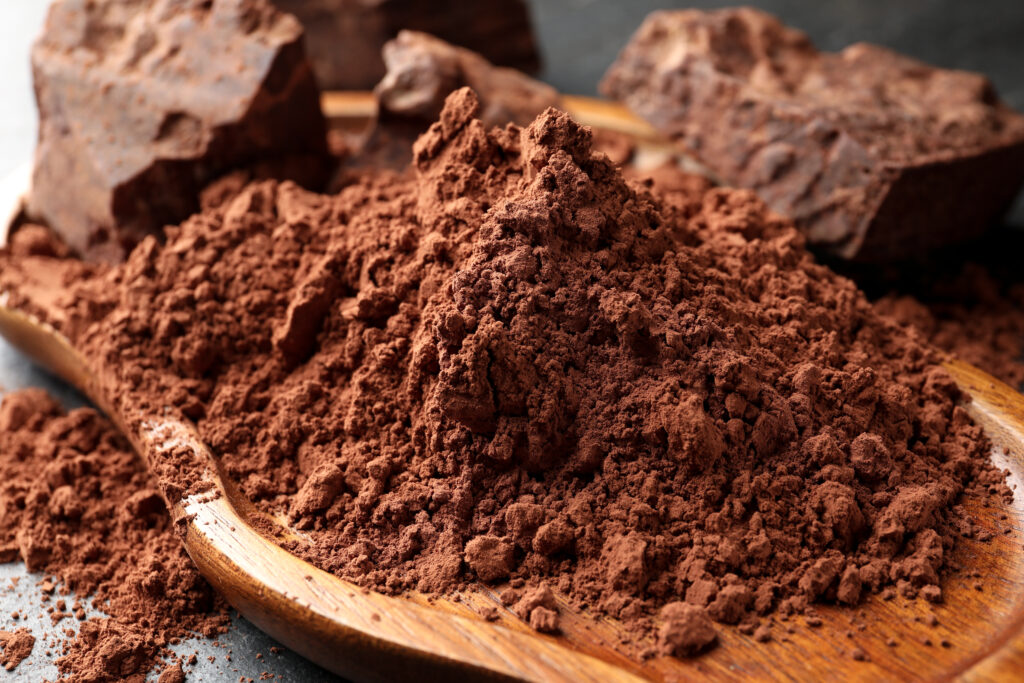
Importing guide
Importing Cocoa Powder for the First Time?
Eight steps from specification and supplier checks to shipping documents and customs.
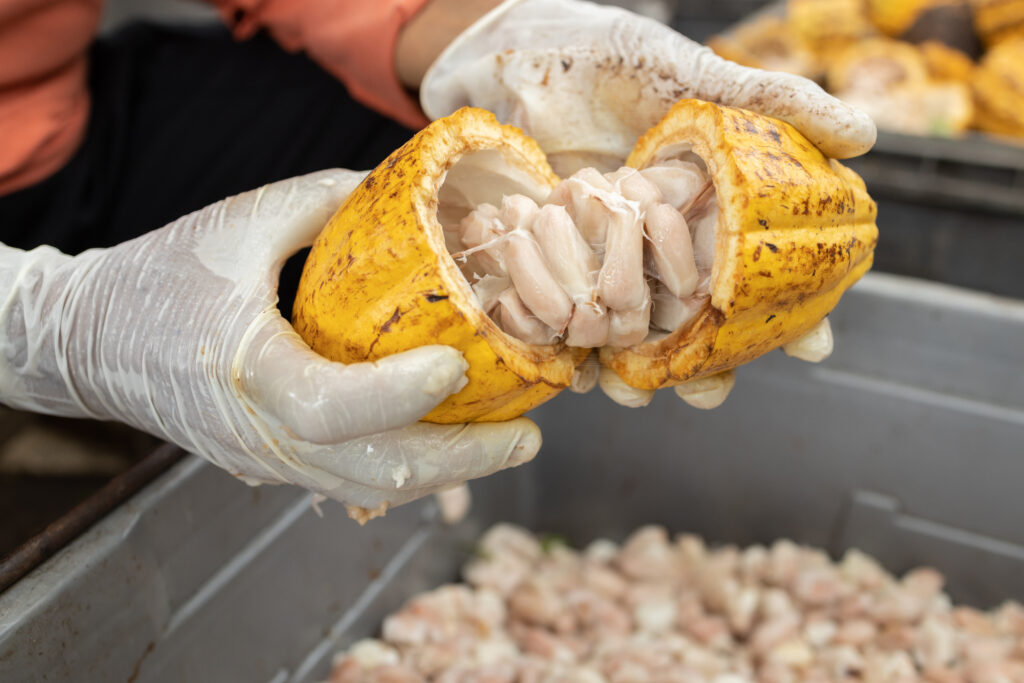
Quality guide
Cocoa Microbiological Specifications and Contaminant Limits
Every limit with its legal basis, plus a certificate of analysis checklist.
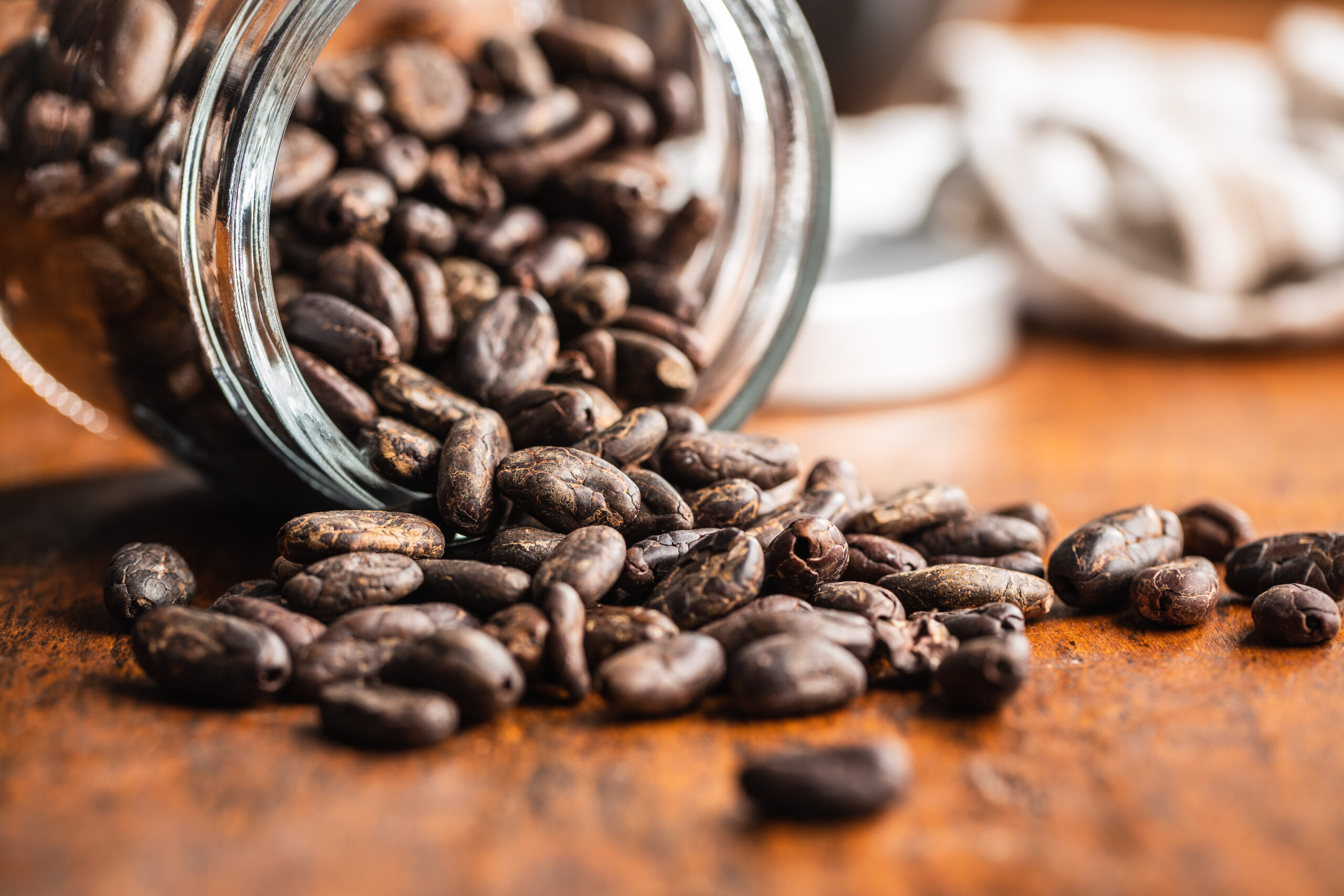
Sourcing
How to Buy and Import Bulk Cocoa Beans
A 7-step guide covering grades, suppliers, Incoterms and EUDR rules.