Cocoa Species:
Varieties &
Global Supply
A complete guide to every major cocoa species, their genetics, flavour profiles, and role in the world’s most beloved crop.
One Species.
Extraordinary Diversity.
Every chocolate bar in the world, from a 50-cent convenience store bar to a hand-crafted single-origin tablet priced at $20, begins life in the same place: a cacao pod growing on a Theobroma cacao tree in the tropics. One species. One plant family. And yet the range of flavours, qualities, and experiences that spring from it is genuinely astonishing.
What makes that possible is variety. Within Theobroma cacao, there is an extraordinary depth of genetic diversity — shaped over thousands of years by geography, climate, human selection, and natural hybridisation. Different varieties of cacao produce beans that taste completely different, yield dramatically different quantities, and carry vastly different commercial values. Understanding cocoa varieties is not a technical exercise reserved for scientists and chocolatiers. It is the foundation of everything in the cocoa supply chain.
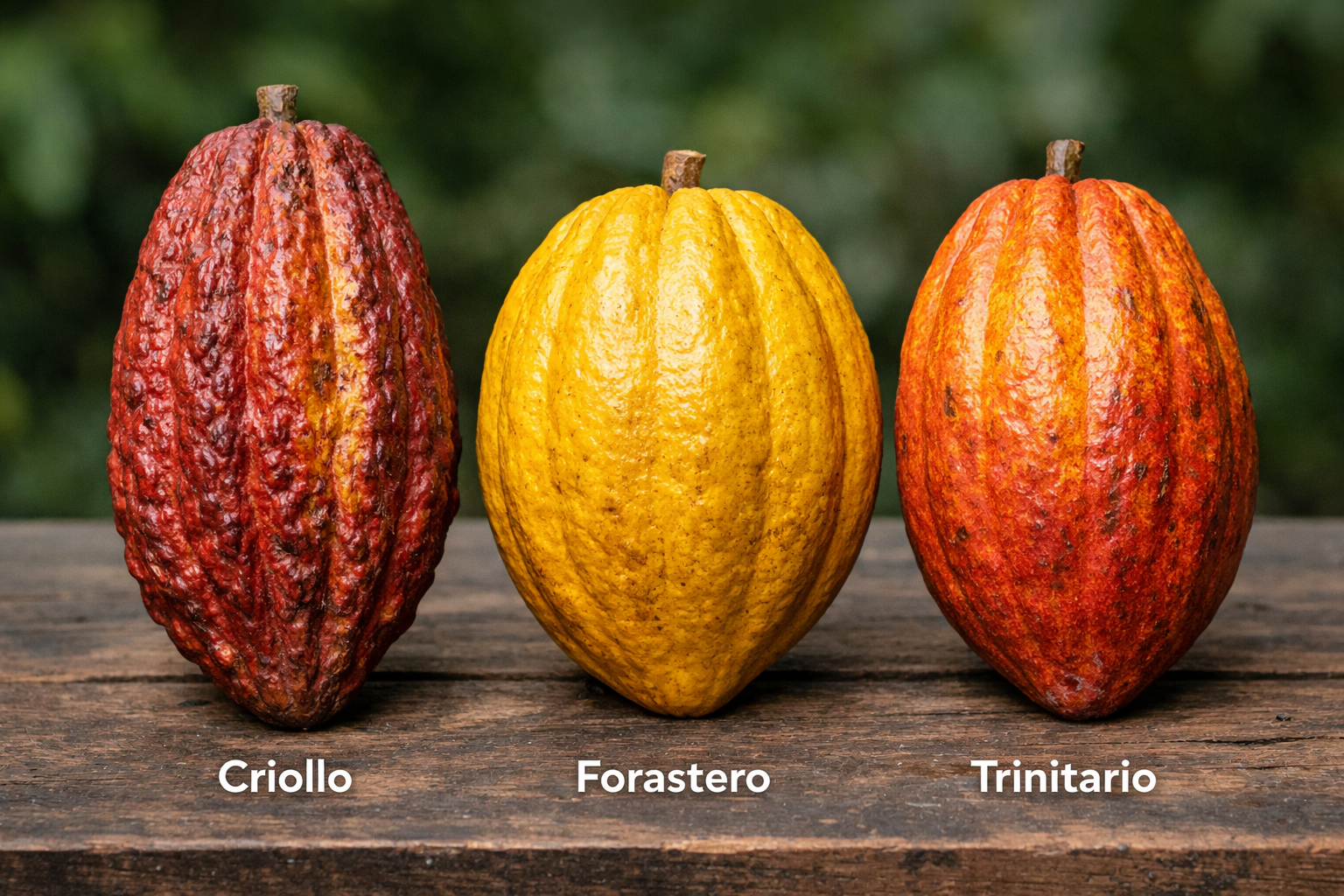
For most of the 20th century, the cocoa industry worked with a simple three-variety framework: Forastero, Criollo, and Trinitario. That classification, formalised by the botanist E. E. Cheesman in 1944, was based on observable physical traits — pod shape, bean colour, tree architecture. It was practical and it stuck. Today, those three names still dominate commercial cocoa language, marketing materials, and most chocolate packaging.
But science has moved on. In 2008, a landmark genetic study by Juan C. Motamayor and colleagues used DNA analysis to reveal that Theobroma cacao actually contains 10 distinct genetic clusters — not three. By 2022, a newly identified 11th cluster (Caquetá) was found in Colombia. This modern genetic map doesn’t replace the commercial classification; it enriches it, and gives farmers, breeders, and buyers a far more precise vocabulary for talking about what they’re growing and trading.
This guide covers both worlds — the traditional commercial varieties you encounter in trade and on chocolate bars, plus additional varieties increasingly recognised by the industry.
📌 Two Valid Frameworks
This blog uses both classification systems in parallel:
- Traditional trade classification (Forastero, Criollo, Trinitario, Nacional, CCN-51) — the standard in commerce, marketing, and most buying/selling contexts
- Modern genetic classification (11 clusters, Motamayor 2008; Caquetá 2022) — used in science, plant breeding, and increasingly in the specialty chocolate industry
Where Cacao Came From:
A 5,000-Year Story
The story of cocoa varieties begins in the Amazon basin of South America. All Theobroma cacao trees trace their ancestry to wild populations in the upper Amazon — the genetic wellspring from which every variety on earth ultimately derives. The earliest confirmed evidence of human cacao use dates to approximately 3,300 BC in what is now Ecuador’s Zamora-Chinchipe province, where the Mayo-Chinchipe culture was using cacao — almost certainly Nacional genetics — as a fermented beverage and a source of nutritional fat.
From these Amazonian origins, cacao spread northward along the Pacific coast and into Mesoamerica, likely carried by ocean-going peoples who traded across remarkable distances. By the time the Olmec civilisation flourished in what is now Mexico (1500–400 BC), cacao had been cultivated and refined into the Criollo variety — its beans lighter, its flavour milder and more complex, having been selected over generations for taste rather than just productivity.
When the Spanish conquistadors arrived in the early 16th century, they encountered Criollo cacao at the centre of Mesoamerican culture — used in sacred ceremonies, traded as currency, and consumed as a bitter beverage prized by nobility. They took it back to Europe, and by the 17th century cocoa plantations were being established across the Spanish, Portuguese, and Dutch empires in West Africa, Southeast Asia, and the Caribbean. The varieties they planted — hardier, more productive, and disease-resistant types different from the Criollo they first met — were called Forastero, meaning “foreign.”
🧬 The Naming of Varieties
The three classical names carry their histories in their words. Criollo meant “native” or “born in this land” in the Spanish of the Americas — it was the cacao the Spanish first knew. Forastero meant “stranger” or “foreigner” — the different varieties brought from elsewhere. And Trinitario simply means “from Trinidad,” reflecting the island where the famous hybrid first emerged.
Earliest Human Cacao Use
Mayo-Chinchipe culture in Ecuador’s Zamora-Chinchipe province uses cacao — likely Nacional genetics — as fermented beverage and fat source.
Olmec Civilisation, Mesoamerica
Criollo cacao, cultivated and refined in Mesoamerica, becomes central to Olmec culture. First domesticated cacao with deliberately selected flavour traits.
Spanish Colonisation & Forastero
Spanish encounter Criollo in Mexico. Portuguese and Dutch begin planting heartier Amazonian varieties (Forastero) across West Africa and Asia. The three-variety divide is born.
Trinitario Emerges, Trinidad
A hurricane and disease outbreak wipes out Trinidad’s Criollo plantations. Surviving trees cross-pollinate with imported Forastero. The Trinitario hybrid is born.
Cheesman’s Classification
Botanist E. E. Cheesman formalises the Criollo / Forastero / Trinitario taxonomy — the three-way classification that still dominates commercial cocoa language today.
CCN-51 Developed & Released
Ecuadorian breeder Homero Castro develops CCN-51 (1965); released publicly in 1984. A high-yield, disease-resistant hybrid that transforms — and controversially dominates — Ecuador’s cacao sector.
Motamayor’s Genetic Study
DNA analysis of 1,241 cacao accessions identifies 10 distinct genetic clusters, overturning the 1944 taxonomy and revealing the true depth of cacao’s biodiversity.
Caquetá: The 11th Cluster
A new study identifies the Caquetá genetic cluster in Colombia’s Caquetá department — proving cacao’s genetic diversity is still being discovered.
Forastero, Criollo & Trinitario:
The Three Pillars of Commercial Cacao
These three varieties have shaped the global chocolate industry for more than a century. They are still the primary framework used in cocoa trading, chocolate marketing, and purchasing decisions worldwide.
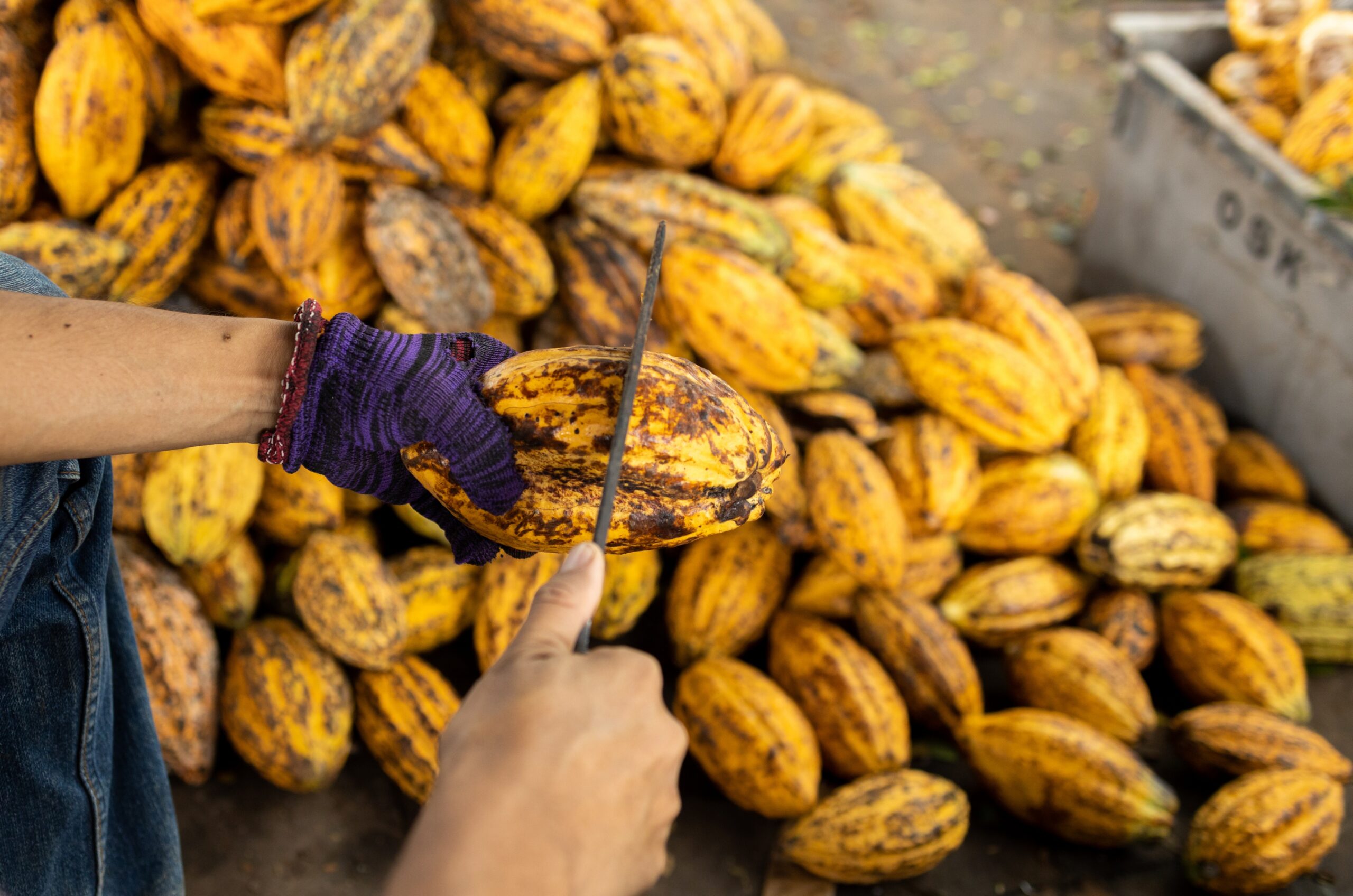
Forastero is the absolute backbone of the global chocolate industry. Accounting for between 80 and 85 percent of everything the world produces, it is the variety that makes chocolate possible at the scale billions of people consume it every day. Named “foreign” by the Spanish because it differed from the Criollo they first knew, Forastero originates from the Amazon basin but found its commercial home in West Africa — where it now defines the vast majority of all cocoa production.
Its commercial dominance comes from a simple combination of traits: it yields abundantly, it resists disease well, and it tolerates the demands of large-scale farming in different climatic conditions. The beans are deep purple when fresh, round, and robust. The chocolate they produce is bold and classic — exactly what mass-market confectionery requires.
- OriginAmazon basin; commercially anchored in West Africa via European colonisation
- Global Share80–85% of world cocoa production (~3.9–4.3M tonnes/yr)
- Main RegionsCôte d’Ivoire, Ghana, Nigeria, Cameroon, Brazil (Bahia)
- Dominant Sub-typeAmelonado (smooth, oval pods; turns yellow when ripe)
- Bean ColourDeep purple (fresh); brown (fermented)
- FlavourBold, strong, classic chocolate; some bitterness; reliable and consistent
- Fermentation5–7 days standard
- Disease Resist.High — primary commercial advantage
- Typical Yield500–1,500 kg/hectare on managed farms
Criollo is the original cultivated cacao — the variety that the Maya and Aztec peoples prized, traded as currency, and offered to their gods. It is the rarest commercially available cocoa on earth, making up less than 5% of global production, possibly as low as 1–2%. Its extreme rarity is a consequence of its very nature: Criollo trees are delicate, susceptible to disease, and relatively low-yielding — all traits that make them impractical for large-scale farming but extraordinary for the chocolate they produce.
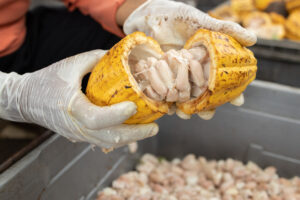
The beans are distinctive: white or pale lilac when fresh rather than the deep purple of Forastero. The chocolate they produce is mild, complex, and remarkably low in bitterness — with flavour notes of red fruit, warm spice, vanilla, and floral aromatics that can persist through multiple taste stages.
- OriginAmazon basin; domesticated in Mesoamerica (Maya, Aztec civilisations)
- Global Share<5% of world supply (possibly 1–2% of truly pure Criollo)
- Main RegionsVenezuela (Porcelana, Chuao, Ocumare), Peru, Honduras, Nicaragua, Java, Sri Lanka
- Bean ColourWhite to pale cream / lilac (fresh) — the most distinctive visual identifier
- FlavourMild, complex, low bitterness; floral, red fruit, spice, vanilla, caramel
- FermentationShorter: 2–4 days (less tannin means less fermentation needed)
- Disease Resist.Low — highly vulnerable; primary reason for rarity
- Typical Yield300–600 kg/hectare (lower than Forastero)
- Notable Sub-typesPorcelana (pure white beans), Chuao (protected Venezuelan terroir), Ocumare
Trinitario is a variety born from catastrophe and necessity. In 1727, a devastating hurricane followed by disease wiped out most of Trinidad’s Criollo plantations. The surviving Criollo trees cross-pollinated naturally with hardier Forastero trees that had been introduced from Venezuela. The result was Trinitario: a natural hybrid that combined much of Criollo’s flavour complexity with Forastero’s disease resistance and productivity. From Trinidad, Trinitario spread throughout the Caribbean, Latin America, and eventually to Southeast Asia and Africa.
Because Trinitario is a hybrid, its characteristics vary significantly depending on which parent’s genetics dominate and where it is grown. Trinitario from Papua New Guinea has a smoky, earthy character (influenced by traditional fire-drying methods). Trinitario from Venezuela’s Sur del Lago region is rich and nutty. This genetic variability is both a challenge and an opportunity for chocolate makers.
OriginTrinidad and Tobago, 18th century — natural Criollo × Forastero cross
Global Share10–15% of world supply (~500,000–700,000 tonnes estimated)
Main RegionsCaribbean, Venezuela, Dominican Republic, Papua New Guinea, Indonesia, Sri Lanka, Cameroon
Bean ColourVariable — mixed light to dark purple depending on parent ratio
FlavourComplex and balanced; fruity, nutty, spicy, rich chocolate; highly terroir-dependent
Fermentation4–6 days (intermediate between both parents)
Disease Resist.Medium to high — significantly better than Criollo
Typical Yield600–1,000 kg/hectare
Notable Sub-typesTSH hybrids (Trinidad Select Hybrids); Sur del Lago (Venezuela); various island types
Complete Comparison: The Three Traditional Varieties
| Characteristic | Forastero | Trinitario | Criollo |
|---|---|---|---|
| Global Production Share | 80–85% | 10–15% | 1–5% |
| ICCO Quality Grade | Bulk / Ordinary | Fine or Flavour ✦ | Fine or Flavour ✦ |
| Annual Volume (est.) | ~3.9–4.3 million tonnes | ~500,000–700,000 tonnes | <200,000 tonnes |
| Primary Producing Region | West Africa (71.5% of world output) | Caribbean, SE Asia, Latin America | Venezuela, Peru, Central America |
| Dominant Sub-type | Amelonado | Various regional hybrids | Porcelana, Chuao, Ocumare |
| Pod Appearance (Ripe) | Oval, smooth, yellow or green-yellow | Variable by region | Long, pointed, warty, red or yellow |
| Fresh Bean Colour | Deep purple | Mixed — light to dark purple | White to pale cream / lilac |
| Flavour Profile | Bold, strong, classic chocolate; reliable; some bitterness | Complex and balanced; fruity, spicy, nutty; terroir-dependent | Very mild, extremely complex; floral, red fruit, low bitterness |
| Fermentation Duration | 5–7 days | 4–6 days | 2–4 days |
| Disease Resistance | High — major commercial advantage | Medium to high | Low — primary reason for rarity |
| Typical Farm Yield | 500–1,500 kg/hectare | 600–1,000 kg/hectare | 300–600 kg/hectare |
| Market Premium vs. Bulk | Commodity (baseline) pricing | 10–30% premium over bulk | 50–200%+ premium over bulk |
| Best Used For | Mass-market chocolate, cocoa powder, industrial confections | Premium and gourmet bars, single-origin chocolate | Ultra-premium luxury chocolate, ceremonial cacao |
| Genetic Status (Modern) | Primarily Amelonado cluster + Upper Amazon types | Criollo × Amelonado + Upper Amazon hybrids | Criollo cluster (distinct; earliest domesticated) |
Sources: ICCO; Wikipedia — Types of Cocoa Beans; Motamayor et al. (2008) PLOS ONE; Cocoa & Heart (2026); Nutrada; Kronchocolatier; Bar & Cocoa
Beyond the Big Three:
Nacional, Amelonado & CCN-51
Three more varieties deserve dedicated attention. One is an ancient heirloom of extraordinary rarity. One is the world’s most commercially widespread cacao type (often grouped under “Forastero” but distinct enough to deserve its own recognition). And one is a modern scientific hybrid that is reshaping Ecuador’s cocoa landscape — for better and for worse.
Nacional is widely regarded as the most aromatic cocoa in the world. Native to Ecuador and among the oldest cultivated cacao varieties on earth, its origins are intertwined with the earliest known human use of cacao — beginning more than 5,000 years ago in Ecuador’s river valleys. Nacional’s flavour signature is unmistakeable: intensely floral, with notes of jasmine, tropical fruit, and a sweetness that lingers long after the chocolate has melted.
Devastated by disease in 1916 and subsequently diluted through decades of hybridisation with Trinitario and CCN-51, pure heirloom Nacional is now extremely rare. It has been rediscovered on isolated farms in Ecuador’s interior, with DNA testing by the USDA Genetic Lab and Cocoa Research Centre Trinidad verifying true Nacional genetics (typically 70–99%). The Heirloom Cacao Preservation Fund actively identifies and maps surviving trees.
- OriginEcuador; Pacific coastal valleys and Amazon headwaters; 3,300 BC earliest use
- Global ShareVery rare; <1% of world supply; heirloom Nacional ~5% of Ecuador’s crop
- Genetic ProfileHeirloom: 70–99% Nacional genetics; Ancient Nacional: 93%+ Nacional
- Main RegionEcuador (Guayas River basin, Arriba region, coastal provinces)
- FlavourIntensely floral; jasmine, tropical fruit, citrus, nuts; low bitterness; distinctive aroma
- ICCO StatusOfficially Fine or Flavour cocoa — one of only three varieties so designated
- Porcelana TypeRare sub-type with white interior beans — among the world’s most prized cacao
- ThreatCCN-51 expansion is replacing Nacional genetics across Ecuador’s cocoa belt
Amelonado deserves its own entry because it is not merely a sub-type of Forastero — it is the most commercially produced specific cacao variety on earth. When people say “West African cocoa,” they are almost always talking about Amelonado. Originally from Eastern Brazil and introduced to West Africa by European colonists in the 19th century, Amelonado has since come to define the cocoa farms of Côte d’Ivoire, Ghana, Nigeria, and Cameroon, which together produce the majority of the world’s cocoa supply.
The Amelonado pod is instantly recognisable: smooth, uniformly oval (melon-shaped — hence the name), with a rounded tip rather than the pointed apex of Criollo. The pods turn a clean yellow when ripe. The beans inside are consistently deep purple and full. Its flavour is reliable and strong — the classic “chocolate” taste that most consumers recognise from everyday chocolate bars.
- OriginEastern Brazil → introduced to West Africa by European colonists, 19th century
- Genetic ClusterAmelonado (one of the 11 scientific genetic clusters)
- Primary RegionsCôte d’Ivoire (~38% of world), Ghana (~13%), Nigeria, Cameroon
- Pod ShapeSmooth, uniformly oval/melon-shaped; rounded tip; turns clean yellow when ripe
- Bean ColourConsistently deep purple (fresh)
- FlavourClassic, reliable chocolate; bold and consistent; good for standardised processing
- YieldHigh and consistent — key reason for its commercial adoption in West Africa
- Disease Resist.High — well-adapted to West African conditions
CCN-51 is one of the most consequential — and most debated — developments in modern cocoa farming. Developed by the Ecuadorian researcher Homero Castro over nearly two decades of selective breeding and released to farmers in 1984, CCN-51 is a meticulously engineered hybrid built around one core objective: maximum yield with strong disease resistance. On both fronts, it delivers spectacularly. Farmers who plant CCN-51 can harvest 1,500 to 2,500 kilograms per hectare — three to five times more than traditional varieties.
The price of that productivity is flavour. CCN-51 is classified as bulk cocoa, and craft chocolate makers are largely dismissive of it. Its natural flavour profile is acidic and astringent — far removed from the floral complexity of Nacional or the elegance of Criollo. Some producers are experimenting with extended and more precise fermentation to improve its flavour potential, with mixed results. The deeper concern is ecological: according to Ecuador’s Ministry of Agriculture, CCN-51 represents 90% of all cacao planted in Ecuador over the past two decades — systematically displacing the ancient Nacional genetics it was designed to replace.
- Genetics45.4% Iquitos (IMC) + 22.2% Criollo + 21.5% Amelonado + 3.9% Contamana + 2.5% Purús + 2.1% Marañon + 1.1% Nacional
- Ecuador Share~70% of total production; 90% of new plantings in the last 20 years
- ExpansionSpreading to Colombia, Peru, and parts of West Africa
- Yield1,500–2,500 kg/hectare — 3–5× higher than traditional varieties
- FlavourAcidic, astringent; classified bulk — not fine or flavour
- Disease Resist.Very high — designed for disease resistance
- Market PriceCommodity/bulk pricing despite Ecuador origin
- ControversyDisplacing irreplaceable Nacional genetics; genetic monoculture risk
⚠️ The CCN-51 Displacement Problem: What the Numbers Show
Ecuador was historically the home of Nacional — one of only three ICCO-designated Fine Flavour cocoa varieties. Today, the data tells a sobering story. According to a study cited by To’ak Chocolate and Ecuador’s Ministry of Agriculture, CCN-51 accounts for approximately 70% of Ecuador’s entire cacao production and represents 90% of all new plantings over the last 20 years. Heirloom Nacional — the variety that traces its roots to 3,300 BC and is considered among the rarest and most aromatic cocoa on earth — now represents only an estimated 5% of Ecuador’s cacao crop at best. Every CCN-51 tree planted occupies land that could have carried Nacional genetics forward. The loss, once made at this scale, is largely permanent.
The 11 Genetic Clusters of
Theobroma Cacao
In 2008, geneticist Juan C. Motamayor and colleagues published a landmark study in PLOS ONE that used 106 microsatellite DNA markers to map the true genetic diversity of cacao. They identified 10 distinct genetic clusters — each named for the Amazonian river basin or region where that particular population was found. By 2022, a new study added an 11th cluster (Caquetá) found in Colombia. These are not marketing categories. They are scientifically verified genetic lineages representing cacao’s true biodiversity.
🔬 How Traditional & Genetic Classifications Relate
“Forastero” in trade language corresponds primarily to the Amelonado genetic cluster (West Africa), plus elements of the Upper Amazon clusters (Iquitos, Nanay, Contamana). “Criollo” maps closely to the Criollo genetic cluster — the only one showing strong domestication signals. “Trinitario” is a hybrid of Criollo + Amelonado + various Upper Amazon types. “Nacional” corresponds to the Nacional genetic cluster. CCN-51 draws from Iquitos (45.4%), Criollo (22.2%), Amelonado (21.5%), and minor contributions from Contamana, Purús, Marañón, and Nacional.
1. Criollo
The domesticated, fine-flavour cluster. Genetically distinct from all Amazonian types due to thousands of years of human selection. Produces white or pale lilac beans. The original cultivated cacao. Strong domestication signals; earliest intentionally bred variety.
2. Amelonado
The most commercially dominant genetic type globally. Smooth, melon-shaped pods. The primary form of Forastero in West Africa. Introduced by European colonists. Accounts for the vast majority of global cocoa production. Significant genetic overlap with Guiana cluster.
3. Nacional
One of the world’s rarest and oldest cultivated clusters. Exceptionally floral flavour — jasmine, tropical fruit. ICCO Fine Flavour designation. Threatened by CCN-51 expansion. Earliest evidence of cacao use (3,300 BC) involves this cluster. Heirloom trees carry 70–99% Nacional genetics.
4. Marañón
Found in the dramatic Marañón Canyon of northern Peru. Renowned for exceptional flavour complexity. Famously produces up to 40% white beans in some populations. Rediscovered commercially around 2009; now used in ultra-premium single-origin chocolate. One of the finest cacao clusters on earth.
5. Nanay
Upper Amazon origin. Critical genetic resource for commercial breeding programs — particularly the ICS and SCA selections developed in Trinidad. A key component of many modern high-yield hybrids, contributing disease resistance traits. Important in the development of TSH (Trinidad Select Hybrid) varieties.
6. Iquitos (IMC)
Also called IMC (Iquitos Mixed Calabacillo). One of the most widely used genetic resources in 20th-century breeding programs globally. Forms the largest single genetic component of CCN-51 (45.4%). Its high disease resistance made it indispensable for hybrid development. Genetically distinct from Nanay despite geographic proximity.
7. Contamana
Also referred to as the Ucayali group. Upper Amazon genetic cluster. Part of CCN-51’s genetic composition (~3.9%). Used in some breeding programs for unique trait combinations. Genetically distinct from Nanay and Iquitos despite sharing Upper Amazon origins. Represented in international gene banks.
8. Curaray
Named after the Curaray River spanning Ecuador and Peru. One of the less well-represented genetic groups in commercial collections. Genetically distinct from other Upper Amazon clusters. Underrepresented in international gene banks — considered an important conservation priority. Taxonomy also references it as LCT EEN.
9. Purús
A distinctive, relatively isolated cluster from the Purús River basin. Pods tend to be small and intensely yellow. Flavour described as spicy and very rich. Some trees still harvested from essentially wild populations in remote river basin areas. Low representation in gene banks; important for conservation. Contributes 2.5% of CCN-51’s genetics.
10. Guiana
Found in the river basins of the Guiana region. Significant genetic overlap with Amelonado — believed to be closely related and possibly representing an early stage of Amelonado’s geographic spread. Less commonly discussed in commercial cocoa contexts but important for understanding how cacao moved from wild Amazonian populations into cultivation.
11. Caquetá
The most recently identified genetic cluster, added by a 2022 research publication. Found in Colombia’s Caquetá department — a region of the Colombian Amazon. Represents unique genetic material not captured in the original 10 Motamayor clusters. Its discovery demonstrates that cacao’s genetic diversity is still being actively mapped, and likely more surprises remain.
Global Cocoa Supply:
The Numbers That Matter
All production and supply figures below are drawn from official ICCO Quarterly Bulletins of Cocoa Statistics and cross-referenced with peer-reviewed agricultural research.
Supply by Variety Type
ICCO Quality Classification
Source: Wikipedia citing ICCO data — “As of 2017, 95% of cocoa produced was bulk cocoa”
Supply by Region (2024/25 ICCO)
Source: ICCO 2024/25 Quarterly Bulletin; statranker.org analysis of ICCO data
📊 ICCO 2024/25 Season: Key Data Points
- World gross production forecast: 4.840 million tonnes (ICCO Feb 2025 bulletin)
- This represents a +7.8% increase vs the 2023/24 season
- 2023/24 actual production: 4.368 million tonnes (down 12.9% year-on-year)
- 2024/25 estimated surplus: +49,000 tonnes — first surplus after two deficit seasons
- 2023/24 deficit was a substantial -489,000 tonnes
- Global grindings 2024/25 projected at 4.650 million tonnes
- Africa accounts for 71.5% of world output; Americas 22.3%; Asia & Oceania 6.2%
Top Producing Countries
Côte d’Ivoire
Amelonado (Forastero) · Largest producer globally · EUDR compliance ongoing
Ghana
Amelonado (Forastero) · Known for quality · CSSV disease challenge
Ecuador
CCN-51 (bulk) + Nacional/Arriba (Fine Flavour) · Unique dual-quality position
Nigeria
Amelonado / Forastero · Growing production and processing capacity
Cameroon
Amelonado + Trinitario mix · Production rose from 122k t (2000) to 290k t (2020)
Indonesia
Forastero + some Trinitario · Asia’s largest producer · Earthy, smoky notes
Peru
Marañón, Nanay, Trinitario · ICCO Fine Flavour · Fast-growing organic sector
Brazil
Forastero + Trinitario · Recovering after Witches’ Broom devastation
Sources: ICCO 2024/25 Bulletins; OEC 2024; CABI Agriculture & Bioscience (2024)
Country-by-Country:
Variety, Volume & Quality Grade
| Country / Region | Est. Annual Volume | % of World Supply | Primary Variety / Type | ICCO Grade | Key Notes |
|---|---|---|---|---|---|
| 🇨🇮 Côte d’Ivoire | ~2.0–2.2M tonnes | ~38% | Amelonado (Forastero) | Bulk | World’s #1 producer; EUDR compliance by Dec 2026 |
| 🇬🇭 Ghana | ~650,000 t | ~13% | Amelonado (Forastero) | Bulk | Premium quality reputation; CSSV disease challenge |
| 🇪🇨 Ecuador | ~300,000 t | ~7% | CCN-51 (bulk) + Nacional (fine) | Bulk + Fine ✦ | CCN-51 ~70% of output; Nacional heirloom ~5% of crop |
| 🇳🇬 Nigeria | ~280,000 t | ~6% | Amelonado / Forastero | Bulk | Growing production; expanding domestic processing |
| 🇨🇲 Cameroon | ~270,000 t | ~6% | Amelonado + Trinitario | Bulk | Production grew from 122,600 t (2000) to 290,000 t (2020) |
| 🇮🇩 Indonesia | ~220,000 t | ~5% | Forastero + Trinitario | Bulk | Asia’s largest; distinctive smoky notes from fire-drying |
| 🇵🇪 Peru | ~140,000 t | ~3% | Marañón, Nanay, Trinitario | Fine ✦ | ICCO Fine Flavour; fast-growing organic sector; 5 of 11 genetic clusters present |
| 🇩🇴 Dominican Republic | ~80,000–100,000 t | ~2% | Trinitario (predominant) | Fine ✦ | Largest Caribbean producer; strong certified organic sector |
| 🇧🇷 Brazil | ~60,000 t | ~1% | Forastero + Trinitario | Bulk | Recovering after Witches’ Broom devastation; Bahia region |
| 🇻🇪 Venezuela | ~20,000–25,000 t | <1% | Criollo + Trinitario | Fine ✦ | Birthplace of Criollo; Porcelana, Chuao, Ocumare — world’s finest cacao |
| 🇲🇬 Madagascar | ~10,000–15,000 t | <1% | Trinitario | Fine ✦ | Distinctive citrus and red berry notes; unique tropical terroir |
| 🇵🇬 Papua New Guinea | ~40,000–50,000 t | ~1% | Trinitario (predominant) | Fine ✦ | ICCO Fine Flavour; smoky character from traditional fire-drying |
| 🌍 Africa Total | ~3,462,000 t | 71.5% | Predominantly Amelonado | Bulk | West African supply dominates global pricing — ICCO 2024/25 |
| 🌎 Americas Total | ~1,079,000 t | 22.3% | Mixed (bulk + fine flavour) | Both | Growing strategic importance; home of fine flavour origins — ICCO 2024/25 |
| 🌏 Asia & Oceania Total | ~300,000 t | 6.2% | Mixed | Mixed | Indonesia dominant for volume; Papua New Guinea for premium — ICCO 2024/25 |
Sources: ICCO Quarterly Bulletins 2024–2025; OEC 2024; CABI Agriculture & Bioscience (2024); statranker.org analysis of ICCO 2024/25 data; Wikipedia — Cocoa Bean; Motamayor et al. (2008); To’ak Chocolate; INIAP Ecuador
Countries Producing
Fine or Flavour Cocoa
The International Cocoa Organization maintains an official list of countries whose cocoa exports are classified as Fine or Flavour — the highest quality grade. These are countries producing Criollo, Trinitario, or Nacional varieties (or pure blends thereof) that carry flavour complexity beyond what standard Forastero/Amelonado can achieve.
🌟 The ICCO Fine Flavour Standard
The ICCO distinguishes between “Fine or Flavour” cocoa beans and “Bulk or Ordinary” cocoa beans. Countries are classified based on the varieties they produce and the market recognition of their cocoa’s quality. Fine Flavour designation is significant because it allows cocoa-producing countries to command price premiums — often 10–50% above bulk commodity pricing — and to position their cocoa for the premium and craft chocolate markets.
Source: ICCO official Fine or Flavour cocoa classification list
The World’s Most Prized
Heirloom Cultivars
Within the broad variety categories, certain specific cultivars — defined by genetics, terroir, and history — have achieved legendary status in the fine chocolate world. These represent cocoa at its most rare, most aromatic, and most extraordinary.
| Cultivar / Name | Parent Variety | Origin & Terroir | Flavour Signature | Rarity & Market |
|---|---|---|---|---|
| Porcelana | Pure Criollo | Lake Maracaibo basin, Venezuela | Entirely white beans; no bitterness; creamy, floral, extraordinarily delicate | One of the world’s most expensive cacao; ultra-premium only |
| Chuao | Criollo / Trinitario | Chuao village, Venezuela (isolated coastal valley) | Deeply complex; fruity, nutty, earthy, caramel; remarkable layered flavour | Protected by Venezuelan law; can only be legally exported by the village cooperative |
| Ocumare | Criollo / Trinitario | Ocumare de la Costa, Venezuela | Fruity and balanced; red berries, gentle earthiness, pleasant bitterness | Highly sought by craft chocolate makers; more accessible than Chuao or Porcelana |
| Ancient Nacional | Nacional (93%+ genetics) | Remote highland farms, Ecuador | Intensely floral; jasmine, tropical fruit, honey; almost no bitterness | Extremely rare; DNA-verified by USDA Genetic Lab and Cocoa Research Centre Trinidad |
| Heirloom Nacional | Nacional (70–99%) | Various provinces, Ecuador | Floral, fruity, aromatic — slightly less pure than Ancient Nacional | ~5% of Ecuador’s crop; prized by specialty makers; ICCO Fine Flavour |
| Marañón Canyon | Marañón genetic cluster | Marañón Canyon, Northern Peru | Exceptional complexity; up to 40% white beans; intense fruit and spice | Ultra-premium; rediscovered ~2009; used by leading craft chocolate makers |
| Sur del Lago | Trinitario | Southern Lake Maracaibo region, Venezuela | Rich chocolate, dried fruits, roasted nuts, mild acidity; elegant structure | Fine flavour premium; regional geographical designation |
| Arriba Nacional | Nacional / Heirloom blend | Ecuador (Guayas River basin) | Ecuador’s trademark floral aroma; fruity, aromatic; ICCO-recognised | Official ICCO Fine Flavour; national designation; wider availability than heirloom |
| TSH Hybrids | Trinitario × Forastero | Trinidad (breeding programs, CRC) | Rich and balanced; consistent flavour with fine flavour complexity | 800–1,200 kg/ha; mid-premium pricing; widely used in Caribbean and beyond |
| Sur del Beni | Criollo / Bolivian wild types | Beni department, Bolivia | Fruity, mild, unique wild cacao character; excellent aroma | Very rare; niche ultra-premium; Bolivia is ICCO Fine Flavour designated |
Sources: To’ak Chocolate; Wikipedia — Types of Cocoa Beans; ICCO; TMA.earth; Bar & Cocoa; Uncommon Cacao; Cocoa & Heart (2026)
Why Cocoa Variety Matters:
To Farmers, Makers & the Planet
🍫 To Chocolate Makers
Variety is the fundamental ingredient that sits beneath all others. A bar made from Criollo and a bar made from Forastero — using identical processing, identical fermentation and roasting — taste completely different. One is bold and straightforward; the other is mild, floral, and layered. Craft chocolate makers choose varieties as deliberately as winemakers choose grape cultivars. The growing movement in “single-origin” and “bean-to-bar” chocolate is, at its core, a movement about variety transparency.
🌾 To Farmers
Variety choice directly determines income for 30+ years — the productive lifespan of a cacao tree. A farmer planting heirloom Nacional can command 50–200% premium over bulk commodity pricing if they can find the right market. But Nacional yields far less per hectare than CCN-51. The economic reality pressures farmers toward high-yield bulk varieties, trapping them in commodity markets with no flavour premium. Interventions like farmer cooperatives, direct trade, and fair pricing programmes that reward fine flavour are essential for keeping heirloom varieties alive.
🌿 To Biodiversity & the Future
The 11 genetic clusters of Theobroma cacao represent an irreplaceable biodiversity bank built over millions of years. Each cluster contains unique traits — disease resistance genes, climate adaptation mechanisms, flavour chemistry pathways — that breeders need to develop cacao varieties capable of surviving a warming planet. As CCN-51 monocultures and Amelonado dominance expand, this genetic diversity is being quietly eroded. Once a genetic lineage is lost from the landscape, it cannot be recreated. The conservation of diverse cacao varieties is not just a flavour question; it is an insurance policy for the entire chocolate industry.
📋 Key Facts: Cocoa Variety & Global Supply at a Glance
- As of 2017, 95% of global cocoa production was bulk/ordinary grade (ICCO / Wikipedia)
- Forastero (primarily Amelonado) accounts for 80–85% of world cocoa — approximately 3.9–4.3 million tonnes annually
- West Africa produces 71.5% of all cocoa (ICCO 2024/25), almost entirely Amelonado
- 11 genetic clusters now identified in Theobroma cacao (Motamayor 2008 + Caquetá 2022)
- CCN-51 now represents ~70% of Ecuador’s total cacao output and 90% of new plantings in the last 20 years
- ICCO Fine Flavour list officially recognises 18 countries for fine or flavour cocoa production
- Pure Criollo makes up <5% of global supply — possibly as low as 1–2% of truly pure trees
- International cocoa gene banks maintain 7,000–10,000 distinct genetic accessions (Cocoa & Heart 2026)
- 2024/25 world production forecast: 4.840 million tonnes (ICCO Feb 2025 Bulletin)
- Côte d’Ivoire alone produces ~38% of world output — almost exclusively Amelonado Forastero
- CCN-51’s full genetic makeup is known: 45.4% Iquitos + 22.2% Criollo + 21.5% Amelonado + minor others
- Heirloom Nacional in Ecuador: estimated ~5% of Ecuador’s crop — and declining
Source Your Cocoa With Confidence.
Radad International.
Whether you’re building a chocolate brand, running a processing operation, or sourcing bulk cocoa for industrial use — Radad International connects you with the right variety, at the right quality, from the right origin. From Forastero and Trinitario to fine flavour Nacional and Criollo-based varieties, our global sourcing network ensures your supply is verified, traceable, and consistent.